New Balance 574 vs 990: The Complete Comparison Guide
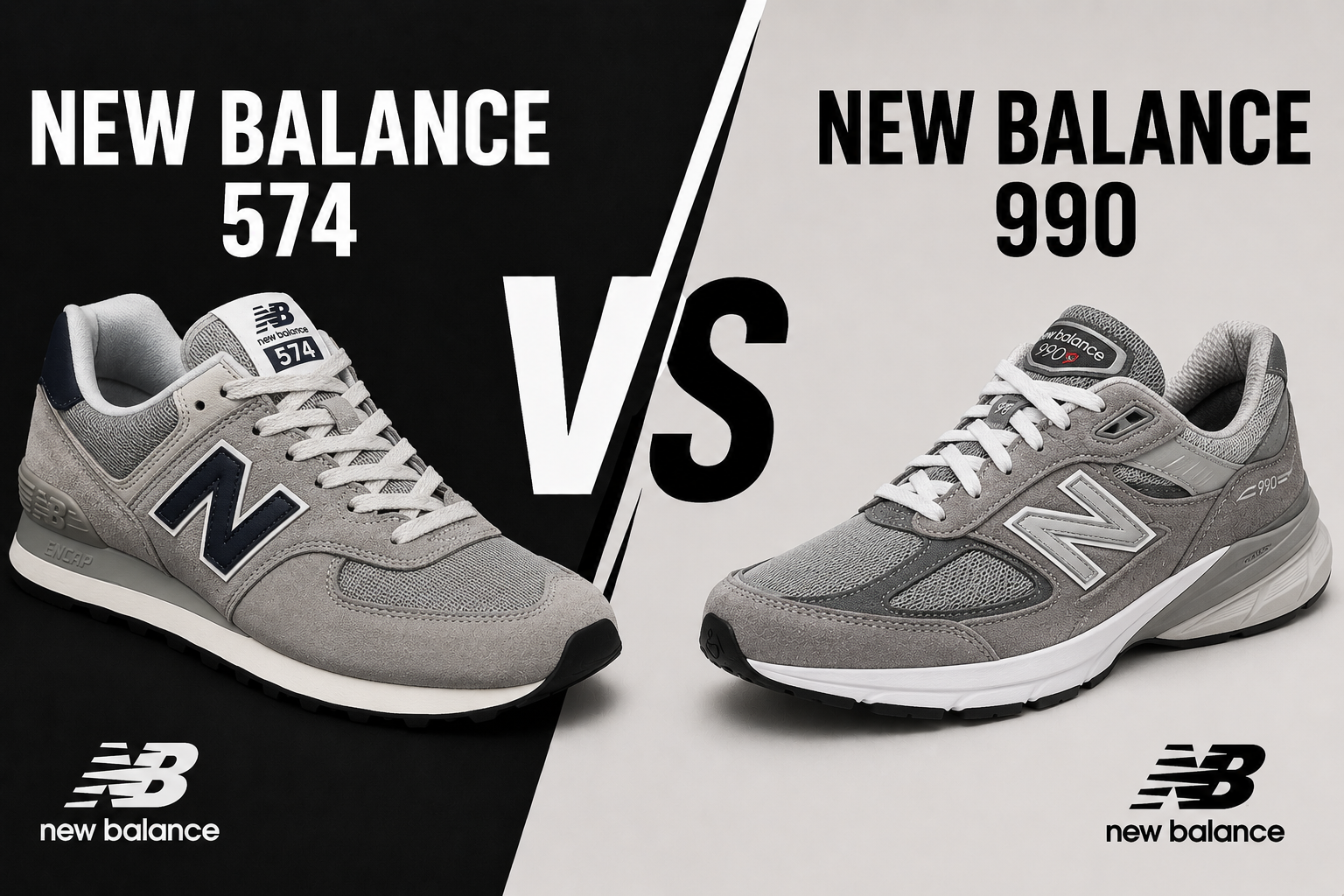
The New Balance 574 vs 990 comparison is really a question about how much you’re willing to pay for a noticeable jump in comfort, materials, and craftsmanship — because both shoes share the same core DNA.
Both use New Balance’s ENCAP midsole system, both trace their design roots back to the 1980s running shoes, and both have become full-blown “dad shoe” icons that transcended their original athletic purpose.
But they sit at very different points on New Balance’s lineup, and the price gap between them (roughly double) reflects real, tangible differences in construction.
The 574 is the brand’s accessible, everyday classic — comfortable, affordable, and endlessly recolored.
The 990, especially in its current 990v6 form, is New Balance’s flagship “Made in USA” line, built with premium materials, added FuelCell cushioning, and a noticeably more refined, structured ride.
If you’re trying to decide between these two comfort sneakers and walking shoes, this guide breaks down exactly what that extra money buys you, and whether it’s worth it for how you’ll actually wear the shoes.
What This Article Will Help You Decide
- Whether the 990’s higher price is justified by real comfort and durability gains
- How the two shoes differ in cushioning, support, and stability
- Which shoe fits wider or narrower feet more comfortably
- Materials and craftsmanship differences, including the 990s ‘ “Made in USA” construction
- Weight and how it affects long walking days
- Durability expectations over months and years of regular wear
- Style versatility across casual, smart-casual, and streetwear outfits
- Value for money and true long-term cost per wear
- Which shoe is the better pick for all-day standing, walking, and travel
- Whether the 990 is truly worth double the price, or whether the 574 covers most people’s needs
Quick Verdict
| Category | Winner |
|---|---|
| Best Overall | New Balance 990 |
| Best for Comfort | New Balance 990 |
| Best for Walking | New Balance 990 |
| Best for Casual Wear | Tie — depends on style |
| Best Value | New Balance 574 |
| Best for Wide Feet | New Balance 990 |
| Best for Narrow Feet | New Balance 574 |
| Best for All-Day Wear | New Balance 990 |
| Best for Travel | New Balance 990 |
| Best Budget Pick | New Balance 574 |
As with any comparison between an entry-level and premium version of a similar design, “best overall” doesn’t mean “best value for everyone.” Your budget should weigh just as heavily as comfort in this particular decision.
Read also: Nike Air Max 270 vs Adidas NMD: The Ultimate Lifestyle Sneaker Comparison
Who Should Buy Each Shoe?
Who Should Buy the New Balance 574
The 574 is the smarter buy if you want a genuinely comfortable, versatile everyday sneaker without spending premium-shoe money.
It’s a great pick for casual wear, moderate walking, and everyday errands, and its lower price point makes it easy to own multiple colorways without a major investment.
A good example: someone who wants one or two reliable, comfortable sneakers in rotation for daily life — running errands, walking the dog, casual weekend wear — without needing top-tier cushioning technology.
Who Should Buy the New Balance 990
The 990 makes more sense if you’re on your feet for extended periods regularly, have wider feet or need structured arch support, or simply want the best cushioning and materials New Balance offers in this silhouette family.
Its FuelCell-enhanced ENCAP midsole and premium suede-and-mesh construction represent a genuine step up in comfort and craftsmanship, and it’s the shoe more likely to be recommended by podiatrists and comfort-focused reviewers for people who spend all day walking or standing.
A good example: someone who walks several miles a day, works a job that keeps them on their feet, or simply wants the most comfortable version of this classic silhouette and is willing to pay for it.
Product Overview
New Balance 574
- Design: Classic low-top running-inspired silhouette introduced in 1988, combining suede, mesh, and synthetic paneling in a simple, recognizable shape
- Materials: Suede, mesh, and synthetic overlays; recycled polyester lining on current Core colorways
- Midsole technology: ENCAP midsole cushioning, combining a supportive polyurethane rim with a lightweight EVA foam core
- Outsole: Simple rubber outsole designed for everyday traction on pavement and light trail surfaces
- Weight: Roughly 11–12 oz per shoe (men’s size 10)
- Breathability: Good — the mesh paneling provides solid airflow for a leather/suede hybrid shoe
- Cushioning: Comfortable and supportive for everyday wear, though noticeably less plush than the 990
- Support: ENCAP rim gives reasonable heel support and stability for a shoe at this price point
- Available colors: Extremely wide range of colorways, from muted neutrals to bold seasonal drops and frequent designer collaborations
- Retail price range: Standard 574 Core colorways typically retail around $100, with special editions and collaborations running $120–$150+
- Intended use: Everyday casual wear, light-to-moderate walking, versatile all-purpose sneaker
New Balance 990 (990v6)
- Design: Premium daily trainer silhouette dating back to 1982, refined through six generations, with a streamlined “Made in USA” construction and pigskin-and-mesh upper
- Materials: Genuine pigskin suede and synthetic overlays over a mesh underlay, largely manufactured domestically with a “70% or more domestic value” standard
- Midsole technology: ENCAP midsole cushioning combined with FuelCell foam in the forefoot for added responsiveness and energy return
- Outsole: Durable, multi-zone blown rubber outsole designed for reliable traction on pavement and mixed urban surfaces
- Weight: Noticeably heavier than the 574, generally in the 13–14 oz range per shoe, reflecting its more substantial, structured build
- Breathability: Comparable to the 574, moderate given the leather-and-mesh construction
- Cushioning: Significantly plusher and more structured than the 574, with a supportive heel and a “propulsive” feel from the FuelCell forefoot
- Support: Notably strong arch and heel support, widely regarded as one of the more stability-focused shoes in this comfort sneaker category
- Available colors: Smaller, more curated colorway rotation, including frequent “Made in USA” and premium collaboration releases
- Retail price range: Standard 990v6 typically retails around $200, roughly double the price of the 574
- Intended use: All-day comfort, extended walking and standing, premium everyday and travel wear
Head-to-Head Comparison
Design
The 574 has a simpler, more streamlined silhouette that leans casual and versatile. The 990 has a chunkier, more structured profile with a visibly more premium build — thicker overlays, a more substantial midsole, and design details (like reflective accents and refined stitching) that reflect its higher price point. If you want understated and easy to match, go with 574. If you want a bolder, more “elevated dad shoe” look, go 990.
Comfort
This is the clearest differentiator in the entire comparison. The 990’s combination of ENCAP and FuelCell cushioning delivers a noticeably plusher, more structured ride than the 574’s simpler ENCAP-only setup. Reviewers consistently describe the 990 as one of the most comfortable shoes in New Balance’s entire lineup, while the 574 is comfortable but clearly a step below.
Fit
Both shoes are known for generous, true-to-size fits with wide width options, which is one of New Balance’s signature strengths as a brand. The 990 tends to run slightly roomier in the forefoot and offers a wider range of true wide-width options, while the 574 fits a bit more like a standard sneaker.
Sizing
Both generally run true to size. The 990 is specifically noted by reviewers as fitting true to size with a roomy toe box, and it’s available in an especially wide range of width options for buyers who need extra room. The 574 also fits true to size, but with a slightly more standard, less specialized width range.
Materials
The gap here is significant. The 990’s genuine pigskin suede and largely domestic “Made in USA” construction represent a real step up in material quality and craftsmanship compared to the 574’s synthetic-leaning suede and overseas manufacturing. This is a major part of why the 990 costs roughly double.
Breathability
Both shoes perform similarly, since both rely on a mix of suede and mesh paneling. Neither is a standout for warm-weather breathability compared to fully mesh sneakers, though both handle moderate airflow reasonably well.
Cushioning
The 990 wins decisively. Independent lab testing of the 990v6 found its midsole notably softer and more forgiving than older, harder EVA-based New Balance models, thanks to the addition of FuelCell foam, while the 574’s ENCAP-only midsole, though comfortable, doesn’t reach the same plushness.
Arch Support
The 990 is widely regarded as offering excellent arch support, aided by its firmer, more structured heel-rim construction and dual-density midsole setup. The 574 offers reasonable support for an everyday sneaker but isn’t specifically built or marketed around structured arch support the way the 990 is.
Heel Support
The 990’s TPU heel counter and more structured build provide firmer, more secure heel lockdown than the 574, which uses a simpler, less reinforced heel construction appropriate for its price point.
Weight
The 574 is noticeably lighter, thanks to its simpler construction and thinner midsole. The 990s added cushioning technology and premium materials, which come with a real weight cost — it’s a heavier shoe overall, which some wearers feel adds a sense of substance and stability, while others find it less nimble for quicker movement.
Traction
Both outsoles perform reliably on flat, dry pavement and mixed urban surfaces. The 990’s multi-zone blown rubber outsole is specifically engineered for durability and consistent grip across varied city terrain, giving it a slight edge for wearers who cover a lot of ground daily.
Durability
The 990’s premium materials and more robust construction generally hold up better over the long term, particularly the genuine suede uppers and reinforced heel structure. The 574 is still a durable shoe for its price point, but its lower-cost materials show wear a bit sooner under heavy daily use.
Flexibility
The 574 flexes a bit more naturally underfoot, given its simpler, lighter midsole. The 990’s thicker, more structured midsole feels firmer and less flexible, particularly when new, though this structure is part of what gives it superior support for extended wear.
Walking Comfort
For long walking days, the 990’s superior cushioning and arch support make it the clear winner, and it’s frequently recommended specifically as a walking shoe by comfort-focused reviewers. The 574 is comfortable for moderate walking, but doesn’t match the 990’s shock absorption over several hours.
Standing All Day
The 990’s structured support and plush FuelCell cushioning make it noticeably better suited to reducing foot fatigue during long shifts or standing-heavy days compared to the 574.
Casual Everyday Wear
Both shoes are excellent everyday sneakers, and this is where the 574 makes its strongest case — for casual, low-intensity daily wear, its comfort is more than sufficient, and its lower price makes it easier to own multiple pairs.
Travel
The 990’s all-day comfort advantage makes it the smarter travel shoe for long days of walking through airports and cities, similar to how premium cushioned walking shoes generally outperform simpler everyday sneakers on multi-day trips.
Cleaning
Both shoes clean up with a soft-bristle brush, mild soap, and water on their mesh sections, and a dedicated suede brush for suede paneling. The 990’s genuine pigskin suede requires slightly more careful maintenance than the 574’s more synthetic-leaning suede to preserve its premium finish.
Maintenance
Rotate socks, apply a suede protector spray to both shoes before first wear, and avoid submerging either in water. Given the 990’s higher price and premium materials, many owners find the extra maintenance effort worthwhile to protect that investment.
Weather Resistance
Neither shoe is waterproof, and reviewers specifically note that the 990v6 soaks in sustained rain and takes a while to dry, since it lacks any waterproof treatment in its standard configuration. The 574 has a similar vulnerability to wet weather, given its comparable suede-and-mesh construction.
Break-in Period
The 574 tends to feel comfortable faster thanks to its lighter, simpler midsole. The 990 has a slightly longer break-in period given its firmer, more structured construction, though most wearers report it breaking in quickly within the first few wears.
Style Versatility
The 574 is arguably the more universally versatile shoe, given its slimmer profile and enormous colorway range that spans neutral, everyday tones to bold statement colors.
The 990 leans into a bolder, chunkier “elevated dad shoe” aesthetic that’s extremely popular right now but slightly more of a style statement than the more understated 574.
Available Colorways
The 574 wins decisively here, with a far larger and more frequently refreshed rotation of colorways and collaborations than the more curated, premium-focused 990 lineup.
Price
The 574 is significantly cheaper, generally retailing at roughly half the price of the 990. This makes it the clear pick for budget-conscious shoppers who still want genuine New Balance comfort and design.
Long-Term Value
Given the 990’s superior comfort, support, and materials for extended everyday and all-day wear, many owners feel its higher price is justified if it’s going into heavy daily rotation. The 574 offers excellent value at its lower price point, particularly for lighter, more casual use.
ENCAP vs. FuelCell: What’s Actually Different Under the Hood
Both shoes share New Balance’s ENCAP midsole system, which combines a durable polyurethane rim around the heel with a lighter EVA foam core in the center.
This construction has been a New Balance signature since the 1980s, and it’s specifically designed to balance stability (from the firmer polyurethane rim) with cushioning (from the softer EVA core) — which is why both the 574 and 990 feel notably more supportive and grounded than a shoe built on foam alone.
The difference is what New Balance adds on top of that shared foundation. The 990v6 incorporates FuelCell foam in the forefoot, a lighter, more responsive compound originally developed for New Balance’s performance running shoes.
Independent lab testing has measured the 990v6’s midsole as notably softer than older, EVA-only New Balance models, largely because the FuelCell layer compresses and rebounds more readily than standard EVA foam.
In practical terms, this gives the 990 a “propulsive” quality underfoot that the 574 simply doesn’t have — a slight forward spring with each step, layered on top of the same structural stability ENCAP has always provided.
This distinction explains the comfort gap buyers consistently report between these two shoes. The 574 gives you genuine ENCAP support and cushioning at an accessible price, which is more than adequate for casual, everyday use.
The 990 takes that same foundational technology and adds a genuinely different cushioning compound on top of it, which is a real engineering upgrade, not just a marketing distinction, and it’s the single biggest reason the 990 costs roughly double what the 574 does.
Real-Life Scenarios
- College students: New Balance 574 — comfortable and budget-friendly for daily campus walking
- Office workers (business casual): New Balance 990 — the more refined, premium look pairs well with smart-casual outfits
- Travelers: New Balance 990 — superior all-day cushioning and support for airports and sightseeing
- Walking all day: New Balance 990
- Standing all day at work: New Balance 990
- Streetwear/casual outfits: New Balance 574 — its slimmer profile and huge colorway range make it easy to match
- Business casual outfits: New Balance 990
- Gym workouts: Neither shoe is designed for serious training — both lack the lateral support needed for lifting or high-intensity cardio, though the 990’s structure holds up reasonably well for treadmill walking
- Long shifts (retail, hospitality): New Balance 990
- Daily commuting: Tie — both handle typical commutes comfortably, though the 990 has an edge on longer commutes
- Vacation: New Balance 990, for the comfort factor over multiple walking-heavy days
- Weekend errands: New Balance 574, for a lighter, more casual everyday feel
Outfit Ideas: New Balance 574
- Straight-leg jeans, plain white tee, denim jacket
- Cargo shorts, graphic tee, baseball cap for summer errands
- Track pants, zip-up windbreaker, crossbody bag
- Chinos, tucked-in polo, minimal watch for smart-casual crossover
- Distressed jeans, plaid flannel worn open, plain tee
- Athletic shorts, ribbed tank, snapback for a sporty casual look
- Cream hoodie, joggers, utility vest
- Denim-on-denim styling with a plain white tee
- Wide-leg trousers, oversized sweater, minimal jewelry
- Corduroy pants, turtleneck, wool coat for a fall layering look
Outfit Ideas: New Balance 990
- Tailored trousers, fitted crewneck, unstructured blazer for smart-casual
- Wide-leg jeans, oversized sweater, minimal accessories
- Chinos, button-down shirt, lightweight overshirt
- Cargo pants, fitted long-sleeve, technical jacket
- Straight-leg jeans, plain tee, suede overshirt
- Pleated trousers, turtleneck, wool coat for elevated fall styling
- Track suit top-to-bottom for a retro athletic look
- Corduroy pants, flannel shirt, puffer vest
- Tailored shorts, polo shirt, crew socks pulled up for preppy-casual
- Minimalist neutral-tone outfit that lets the shoe’s premium materials stand out
Best Alternatives
- New Balance 993 — another premium “Made in USA” option, slightly more understated than the 990
- New Balance 550 — a chunkier, retro-basketball-inspired alternative with strong crossover appeal
- New Balance 2002R — a max-cushioned, chunkier alternative for buyers who want even more comfort
- Nike Air Force 1 — a Nike alternative with a similarly cushioned, chunky silhouette
- Adidas Samba — a flatter, more minimal retro alternative for buyers who want less bulk
- New Balance 9060 — a bold, retro-futuristic alternative with excellent cushioning
- Asics Gel-Kayano — a performance-leaning alternative for buyers who want serious arch support in a running-inspired shoe
- New Balance 530 — a lighter, more affordable everyday alternative similar in spirit to the 574
- Brooks Ghost — a running-focused alternative for buyers who want the 990’s comfort philosophy in a true performance shoe
- Hoka Bondi — a max-cushioned alternative for buyers who want even more plush comfort than the 990 offers
Pros and Cons
New Balance 574 — Pros
- Significantly more affordable than the 990
- Lighter weight for a more nimble, casual feel
- An enormous range of colorways and collaborations
- Comfortable enough for everyday, moderate use
- Versatile, understated design that matches almost any outfit
New Balance 574 — Cons
- Less cushioned than the 990 for extended walking or standing
- Less structured arch and heel support
- Lower-cost materials show wear a bit sooner under heavy use
- Narrower range of width options compared to the 990
New Balance 990 — Pros
- Significantly more plush, structured cushioning thanks to FuelCell foam
- Excellent arch and heel support, ideal for extended wear
- Premium “Made in USA” materials and craftsmanship
- Wide range of width options, including true wide sizing
- Strong reputation as one of the best comfort sneakers on the market
New Balance 990 — Cons
- Roughly double the price of the 574
- Noticeably heavier
- Smaller, more curated colorway selection
- Firmer break-in period given its more structured build
Common Mistakes Buyers Make
- Assuming the 574 and 990 offer similar comfort: The 990’s added FuelCell cushioning is a genuine engineering upgrade, not just a marketing difference — buyers expecting 990-level comfort from the 574 are often disappointed.
- Overpaying for the 990 without needing its extra support: If you’re mostly using the shoe for light, casual wear rather than extended walking or standing, the 574 may deliver more than enough comfort for significantly less money.
- Ignoring foot width: Both shoes offer wide sizing, but the 990 has a notably broader range of true wide-width options; wide-footed buyers should check available widths carefully before choosing between the two.
- Buying either shoe for serious athletic training: Neither is built for running, lifting, or high-intensity workouts — both are designed as everyday comfort and lifestyle sneakers first.
- Skipping suede protection: Genuine pigskin suede on the 990, and the suede overlays on the 574, both stain easily without a protective spray applied before first wear.
Care Guide
Cleaning: Remove laces and insoles before cleaning. Use a soft-bristle brush with mild soap and warm water on mesh sections, and a dedicated suede brush for suede paneling on both shoes. Wipe with a damp cloth to remove residue, then air-dry away from direct heat or sunlight.
Storage: Store both shoes with shoe trees or stuffed with paper to help them keep their shape, and store away from direct sunlight, which can degrade both the suede and the midsole foam over time.
Maintenance: Apply a suede protector spray every few weeks of regular wear, particularly important for the 990’s genuine pigskin suede. Rotating between multiple pairs significantly extends the lifespan of the cushioning and outsole on both models.
Increasing lifespan: Avoid machine washing either shoe, and avoid prolonged exposure to rain, since neither model includes waterproofing in its standard configuration. Address scuffs and stains promptly rather than letting them set, and replace insoles periodically if you want a comfort refresh without buying a new pair.
When to Choose the New Balance 574
- Your budget favors the significantly more affordable option
- You want a lighter, more casual everyday sneaker
- You’re mostly using the shoe for light-to-moderate walking rather than extended standing
- You want maximum colorway variety to build out a casual rotation
- You have narrower feet or don’t need extensive wide-width options
When to Choose the New Balance 990
- Comfort and structured support are your top priority
- You’re on your feet for extended periods regularly — walking, standing, or traveling
- You have wider feet or need true wide-width sizing
- You’re willing to pay a premium for genuine “Made in USA” materials and craftsmanship
- You want the most comfortable, best-supported shoe New Balance offers in this silhouette family
Final Verdict
This comparison is less about two competing designs and more about how much extra comfort and craftsmanship is worth to you.
The New Balance 990 wins decisively on cushioning, support, and materials — its FuelCell-enhanced ENCAP midsole and premium “Made in USA” construction represent a real, measurable upgrade over the 574, and it’s the clear choice for anyone who’s on their feet for extended periods regularly.
The New Balance 574 counters with a significantly lower price, a lighter everyday feel, and a much wider range of colorways, making it an excellent choice for casual, moderate use.
If comfort and all-day support are non-negotiable and your budget allows for it, the 990 is worth the extra cost. If you want a genuinely comfortable, versatile everyday sneaker without the premium price tag, the 574 covers the vast majority of daily needs perfectly well.
Many New Balance fans eventually own both — 574s for casual rotation, 990s for travel and long days on their feet — which, if your budget allows, is a smart way to cover every use case.
Frequently Asked Questions
Is the New Balance 990 worth the extra money over the 574? For extended walking, standing, or travel, generally yes — the 990’s FuelCell-enhanced cushioning and premium materials represent a genuine comfort upgrade. For casual, moderate use, many people find the 574 more than sufficient.
Does the New Balance 574 run true to size? Yes, the 574 generally fits true to size with a standard width range.
Does the New Balance 990 run true to size? Yes, the 990 fits true to size and is available in an especially wide range of width options, including true wide sizing.
Which shoe is better for wide feet? The New Balance 990 generally accommodates wide feet better, thanks to its broader range of available widths and roomier forefoot.
Which shoe is better for narrow feet? The New Balance 574’s slightly more standard, less specialized width range tends to suit narrower feet a bit better.
Are the 574 or 990 better for walking all day? The New Balance 990 is the better choice for extended walking thanks to its superior FuelCell-enhanced cushioning and arch support.
Which shoe is more durable? The New Balance 990’s premium suede and more robust construction generally hold up better over the long term compared to the 574’s more budget-friendly materials.
Can you wear the 574 or 990 for exercise or training? Neither is designed for serious athletic training. Both lack the lateral support and structure needed for running, lifting, or high-intensity workouts.
Which shoe is cheaper? The New Balance 574 is significantly cheaper, generally retailing at roughly half the price of the 990.
How do you clean New Balance 574 or 990 sneakers? Use a soft-bristle brush with mild soap and warm water on mesh sections, a dedicated suede brush for suede paneling, wipe clean, and air-dry away from direct sunlight or heat.
Do the 574 and 990 work for business casual outfits? The 990 leans slightly more versatile for business casual thanks to its more refined, premium construction, though both can work depending on the rest of the outfit.
Which shoe has more colorway options? The New Balance 574 has significantly more colorways and collaborations available at any given time compared to the more curated 990 lineup.
Is the New Balance 990 waterproof? No, the standard 990v6 is not waterproof and will soak through in sustained rain, taking a while to dry. The same limitation applies to the 574.
Which shoe is heavier? The New Balance 990 is noticeably heavier than the 574, a trade-off for its additional cushioning technology and more structured construction.
Should I buy both the New Balance 574 and the 990? If your budget allows, yes — they serve different purposes (affordable, casual everyday wear versus premium, all-day comfort and support) and complement each other well in a rotation.
Read also: