Asics Gel-Kayano vs Brooks Ghost: The Complete Comparison Guide
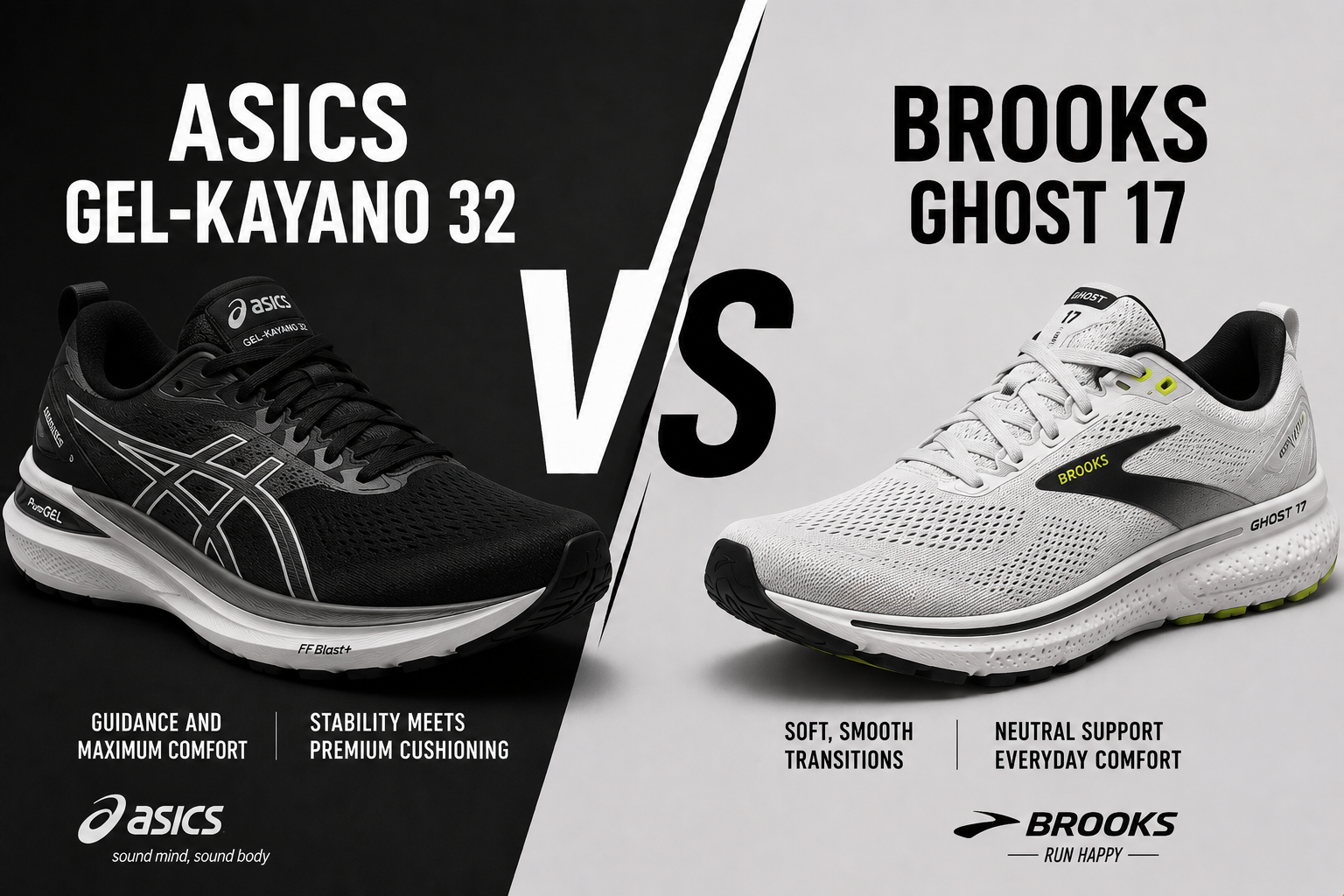
The Asics Gel-Kayano vs Brooks Ghost comparison comes up constantly among runners shopping for a dependable daily trainer, but it’s worth clearing something up right away: these two shoes aren’t technically in the same category.
The Gel-Kayano is Asics’ flagship stability shoe, built specifically with guidance features for runners who need extra structural support.

The Ghost is Brooks’ flagship neutral trainer — supportive and stable-feeling underfoot, but not engineered with the same dedicated stability architecture as the Kayano.
That distinction matters, and we’ll unpack it in detail below, but it doesn’t make this any less of a useful comparison, since both shoes compete for the exact same shopper: someone who wants a comfortable, reliable, well-cushioned daily trainer that can handle serious weekly mileage.

Now in its 32nd generation, the Gel-Kayano has been a go-to stability trainer since 1993, refined through decades of “kaizen” — continuous improvement — while staying true to its supportive, structured DNA.
The Ghost, now in its 17th generation, has built its reputation on being Brooks’ most dependable, no-nonsense daily trainer: comfortable, consistent, and built to disappear underfoot.
This guide breaks down comfort, stability, cushioning, durability, and price — with ratings throughout — so you can figure out which shoe actually fits your gait, your mileage goals, and your budget.

What This Article Will Help You Decide
- Whether you actually need a dedicated stability shoe or a well-cushioned neutral trainer
- How the two shoes compare in cushioning, stack height, and underfoot feel
- Which shoe fits wider or narrower feet more comfortably
- Weight differences and how they affect pace and fatigue over long runs
- Durability and realistic mileage lifespan for both shoes
- Breathability and how each performs across seasons
- Style versatility for wearing these shoes casually, not just for training
- Value for money at each shoe’s price point
- Which shoe is the smarter choice for overpronators versus neutral runners
- Full ratings breakdown so you can compare at a glance
Quick Verdict
| Category | Winner |
|---|---|
| Best Overall | Brooks Ghost |
| Best for Comfort | Asics Gel-Kayano |
| Best for Stability/Overpronation | Asics Gel-Kayano |
| Best for Neutral Runners | Brooks Ghost |
| Best for Walking/Standing All Day | Asics Gel-Kayano |
| Best Value | Brooks Ghost |
| Best for Wide Feet | Brooks Ghost (available widths) |
| Best for Narrow Feet | Asics Gel-Kayano |
| Best for Durability | Asics Gel-Kayano |
| Best for Casual Wear | Brooks Ghost |
Keep in mind these are general leans based on how each shoe is engineered. If you know you overpronate or have been told by a specialist you need stability support, that single factor should outweigh most other considerations in this table.
Read also: Adidas Campus 00s vs Samba: The Complete Comparison Guide (2026)
Ratings At a Glance
| Category | Asics Gel-Kayano 32 | Brooks Ghost 17 |
|---|---|---|
| Comfort | ★★★★★ (4.7/5) | ★★★★☆ (4.3/5) |
| Cushioning | ★★★★☆ (4.3/5) | ★★★★☆ (4.0/5) |
| Stability/Support | ★★★★★ (4.8/5) | ★★★☆☆ (3.5/5) |
| Weight/Agility | ★★★☆☆ (3.0/5) | ★★★☆☆ (3.3/5) |
| Breathability | ★★★☆☆ (3.5/5) | ★★★☆☆ (3.3/5) |
| Durability | ★★★★★ (4.8/5) | ★★★★☆ (4.2/5) |
| Value for Money | ★★★★☆ (4.0/5) | ★★★★☆ (4.0/5) |
| Wet Traction | ★★★★☆ (4.0/5) | ★★★☆☆ (3.0/5) |
| Overall Rating | ★★★★☆ (4.4/5) | ★★★★☆ (4.0/5) |
These ratings reflect a synthesis of independent lab testing and long-term reviewer feedback rather than either brand’s own marketing claims, and they’re most useful as a relative comparison between these two specific shoes rather than an absolute universal score.
Who Should Buy Each Shoe?
Who Should Buy the Asics Gel-Kayano
The Gel-Kayano is the better call if you know you overpronate, have been told you need extra stability support, or simply find that a more structured, guided ride feels better on your joints over long miles.
Its 4D Guidance System and wide, supportive base are specifically engineered to gently correct excessive inward foot roll, and its excellent shock absorption makes it a favorite among heavier runners and those logging serious weekly mileage.
A good example: a marathon runner with a history of mild overpronation who needs a dependable, structured daily trainer that can handle high mileage without breaking down.
Who Should Buy the Brooks Ghost
The Ghost makes more sense if you’re a neutral runner who doesn’t need dedicated stability features but still wants a supportive, well-cushioned, reliable daily trainer.
It’s lighter on the wallet, offers a wider range of true width options (narrow through extra wide), and has built a reputation over 17 generations as one of the most consistent, dependable shoes in running.
A good example: someone training for their first half-marathon who wants one dependable, comfortable shoe that handles everything from easy runs to moderate long runs without needing specialized stability support.
Product Overview
Asics Gel-Kayano (Gel-Kayano 32)
- Design: Premium stability trainer with a big, structured platform, refined through 32 generations since 1993
- Materials: Single-layer engineered mesh upper, redesigned for breathability, with a plush, well-padded heel collar and reinforced tongue wing for arch support
- Midsole technology: FF Blast+ Eco foam (made with 24% bio-based renewable content), combined with PureGEL cushioning in the heel and the brand’s 4D Guidance System for adaptive stability
- Outsole: Hybrid ASICSGRIP and AHARPLUS rubber, with 4.5mm of rubber thickness for exceptional outsole durability
- Weight: Approximately 10.4-10.8 oz per shoe (men’s size 9-9.5), on the heavier end for a daily trainer
- Breathability: Decent, with a lab-tested breathability score in the “good” range, though some reviewers note it can run warm on hot days
- Cushioning: Plush, firm-but-smooth, with a 40mm heel and 32mm forefoot stack height and an 8mm drop
- Support: Excellent — the 4D Guidance System and wide base provide genuine, adaptive stability without feeling overly corrective
- Available colors: Wide range of colorways, refreshed regularly
- Retail price range: Standard retail sits at approximately $165
- Intended use: Daily training, long runs, recovery jogs, and extended walking or standing for runners who benefit from stability support
Brooks Ghost (Ghost 17)
- Design: Classic, no-frills neutral daily trainer, refined through 17 generations, built to “disappear underfoot”
- Materials: Double jacquard air mesh upper with a generously padded tongue and heel collar for a plush, sock-like step-in feel
- Midsole technology: Nitrogen-infused DNA LOFT v3 foam, offering a balanced blend of softness and responsiveness
- Outsole: Durable rubber outsole with a thick 4.0mm rubber layer, prioritizing longevity over minimal weight
- Weight: Approximately 10.2 oz per shoe (men’s size 9), moderately heavy but described by reviewers as still feeling nimble
- Breathability: Decent — the engineered mesh pulls sweat away from the foot effectively, though some reviewers note it could be more ventilated
- Cushioning: Soft and dynamic with a smooth ride, featuring a 36.5mm heel and 26.5mm forefoot stack height and a 10mm drop
- Support: Good general support for a neutral shoe, with a wider platform at the forefoot and heel than previous versions, but no dedicated stability/guidance technology
- Available colors: Wide range, including understated and vibrant options, and available in narrow, regular, wide, and extra wide widths
- Retail price range: Standard retail sits at approximately $150
- Intended use: Daily training, easy-to-moderate mileage, casual everyday wear, and general-purpose running for neutral gaits
Head-to-Head Comparison
Design
The Gel-Kayano has a bulkier, more overtly structured look, reflecting its dedicated stability engineering, though its most recent version has been slimmed down for a more tailored fit than previous generations. The Ghost has a cleaner, more understated silhouette that leans into Brooks’ “no gimmicks” reputation. If you want a shoe that visually and physically signals serious support, lean Kayano. If you want something that looks and feels like a straightforward, dependable trainer, lean Ghost.
Comfort
Both shoes rate highly for comfort, but reviewers consistently describe the Kayano as a “disappears-on-foot” kind of shoe, with premium, soft-touch materials throughout the upper and a plush, well-padded heel collar. The Ghost is also very comfortable, with an especially plush tongue and collar, though its narrower toe box has drawn more criticism than the Kayano’s roomier fit.
Fit
The Kayano fits true to size with just enough room in the toe box and a secure, no-slip heel lockdown. The Ghost also fits true to size overall, but multiple reviewers specifically flag its toe box as narrow and shallow, recommending sizing up or choosing the wide option for anyone with wider or higher-volume feet.
Sizing
Both shoes are generally recommended as true to size. The Ghost offers a notably wider range of width options — narrow, regular, wide, and extra wide — giving it an edge for shoppers who need more flexibility in width. The Kayano’s available widths are more limited, though its standard fit tends to accommodate an average-to-slightly-wide foot reasonably well.
Materials
Both uppers use premium, soft-touch engineered mesh. The Kayano’s newly redesigned single-layer mesh prioritizes breathability improvements over the previous version, while the Ghost’s double jacquard air mesh feels equally plush but has been noted as running warmer in certain conditions despite effective moisture-wicking performance.
Breathability
Both shoes are middling to decent rather than standout performers here. The Kayano scored well in independent lab breathability testing, pulling sweat away from the foot effectively, though some hands-on reviewers still found it ran hot on warm days. The Ghost also manages moisture reasonably well but has similarly been flagged by reviewers as not the most breathable option in its class.
Cushioning
The Kayano has a taller stack height (40mm heel / 32mm forefoot) compared to the Ghost (36.5mm heel / 26.5mm forefoot), and lab testing shows the Kayano delivering excellent shock absorption, particularly suited to heavier runners. That said, several reviewers note the Ghost’s cushioning feels deeper and more lively than its stack height alone would suggest, thanks to the responsive character of DNA LOFT v3 foam.
Arch Support / Stability
This is the single biggest differentiator between these two shoes. The Kayano’s 4D Guidance System is a purpose-built stability architecture, combining built-up sidewalls, a wide base, and varying foam density to actively help prevent the foot from rolling excessively inward. The Ghost, while feeling stable and supportive underfoot thanks to a wider platform in its latest version, is fundamentally a neutral shoe without dedicated pronation-control technology. Runners who specifically need stability support should not treat these two shoes as interchangeable.
Heel Support
The Kayano’s redesigned heel geometry and padded heel cup deliver excellent, secure lockdown, reinforced by the surrounding foam rim. The Ghost also offers solid heel lockdown, aided by a semi-rigid plastic heel overlay, though it’s a less structured system than the Kayano’s dedicated guidance architecture.
Weight
Both shoes sit in a similar, moderately heavy weight class for daily trainers — the Kayano at roughly 10.4-10.8 oz and the Ghost at roughly 10.2 oz per shoe. Neither is a lightweight option, and both have drawn some criticism from reviewers who’d like to see either brand trim weight in future versions, but reviewers of both shoes note the extra weight isn’t especially noticeable during easy-paced running.
Traction
The Kayano’s hybrid ASICSGRIP and AHARPLUS rubber outsole has earned strong marks for reliable grip across dry and wet conditions alike, with reviewers reporting confidence even on damp roads and light trail sections. The Ghost’s outsole, by contrast, has been specifically flagged by multiple reviewers as underperforming in wet conditions due to its harder rubber compound, making it a better fit for drier climates or predominantly dry-road running.
Durability
The Kayano wins clearly here. Independent lab testing found its outsole lost minimal rubber thickness even under aggressive wear testing, a standout result among stability shoes, and its overall build quality is frequently praised as built to last. The Ghost also performs well in durability testing, with strong marks for heel padding and outsole wear resistance, but it doesn’t quite match the Kayano’s exceptional outsole longevity.
Flexibility
The Ghost is generally the more flexible, nimble-feeling shoe of the two, in part due to its lower stack height and more moderate drop structure. The Kayano’s thicker, structured midsole makes it feel more “planted” and less flexible, which is by design — that structure is precisely what enables its stability features to function.
Running Performance
Both shoes are best suited to easy-to-moderate paces rather than speed work. The Kayano provides a distinct, guided sensation of forward motion that many stability-seeking runners appreciate, though its bulk becomes more noticeable at faster paces. The Ghost offers a smoother, more versatile ride across a slightly broader range of paces, including some tempo-adjacent effort, without feeling as heavy underfoot as its spec sheet might suggest.
Walking Comfort
The Kayano is frequently recommended not just for runners but for anyone who’s on their feet all day, having earned the APMA Seal of Acceptance for foot health — a strong signal for walking and standing comfort. The Ghost is also comfortable for walking, and its lighter overall feel makes it a solid all-purpose option, though it lacks the specific stability engineering that makes the Kayano such a strong recommendation for extended standing.
Casual Everyday Wear
Both shoes work well for casual wear, with the Ghost specifically praised by reviewers as a versatile companion for both running and everyday use thanks to its cozy, flexible build. The Kayano’s bulkier stability-focused silhouette is less of a natural crossover into general lifestyle wear, though its comfort makes it a strong choice for all-day errands regardless.
Price
The Ghost is generally cheaper at standard retail — around $150 compared to the Kayano’s approximately $165 — making it the more budget-friendly pick for runners who don’t specifically need stability features.
Long-Term Value
Given the Kayano’s exceptional outsole durability and genuine stability engineering, many overpronating runners find its price fully justified for the injury-prevention and comfort benefits it provides over serious mileage. The Ghost offers excellent value for neutral runners at a slightly lower price point, backed by a well-earned reputation for consistency across nearly two decades of iterations.
Stability vs. Neutral: Why This Comparison Isn’t Quite Apples-to-Apples
It’s worth being direct about something many comparison articles gloss over: the Gel-Kayano and Ghost occupy genuinely different categories in running shoe design, even though they’re frequently cross-shopped. Stability shoes like the Kayano are engineered with specific structural features — Asics’ 4D Guidance System combines built-up sidewalls, varying foam density under the arch, and a wide base specifically to counteract excessive inward foot roll (overpronation) during your gait cycle. This isn’t a marketing flourish; it’s a genuine mechanical intervention in how the shoe behaves as your foot lands and rolls through each stride.
The Ghost, despite feeling stable and well-supported underfoot, is fundamentally a neutral trainer. Its wider platform in the latest generation improves how “planted” it feels compared to earlier versions, but it doesn’t include the kind of guided support architecture that defines a true stability shoe.
If you’re specifically shopping for the Ghost because a specialist told you that you need stability support, you may actually want to look at Brooks’ dedicated stability line, the Adrenaline GTS, rather than the Ghost.
This distinction matters more than most spec-sheet comparisons because gait mechanics have real injury-prevention implications. Runners with significant overpronation who train in neutral shoes for extended mileage sometimes experience increased strain on the ankles, knees, or hips over time, which is exactly the scenario stability shoes like the Kayano are designed to help mitigate.
If you’re not sure which category actually fits your gait, a gait analysis at a specialty running store — many offer this free with a shoe purchase — is a genuinely more reliable way to decide between these two shoes than reading reviews alone.
Real-Life Scenarios
- Runners with known overpronation: Asics Gel-Kayano — purpose-built stability support
- Neutral runners wanting a dependable daily trainer: Brooks Ghost
- College students: Brooks Ghost — lighter on the wallet and versatile for both training and casual wear
- Marathon training (high weekly mileage): Asics Gel-Kayano — superior shock absorption and durability for heavier training loads
- Standing all day at work: Asics Gel-Kayano — APMA-recognized for foot health
- Walking all day: Asics Gel-Kayano
- Casual/athleisure outfits: Brooks Ghost, for its lighter, more versatile everyday feel
- Wide feet: Brooks Ghost, thanks to its wider range of available widths
- Wet-weather running: Asics Gel-Kayano, for its stronger wet-traction performance
- First-time marathon or half-marathon runners: Brooks Ghost, for its simple, dependable, well-rounded ride
- Runners recovering from injury with a known stability need: Asics Gel-Kayano
- Budget-conscious daily training: Brooks Ghost
Outfit Ideas: Asics Gel-Kayano
- Joggers, oversized hoodie, crossbody bag for an athleisure-casual look
- Compression tights, performance long-sleeve, running vest
- Running shorts, moisture-wicking tank, lightweight windbreaker
- Track pants, zip-up jacket, baseball cap
- Athletic shorts, ribbed tank, snapback for casual athletic wear
- Leggings, cropped jacket, minimal accessories for a gym-to-street transition
- Matching tracksuit for a full athletic look
- Straight-leg joggers, plain tee, puffer vest for cold-weather training
- Cargo shorts, technical polo, baseball cap for warm-weather errands
- Layered activewear with a light rain jacket for wet-weather runs
Outfit Ideas: Brooks Ghost
- Running shorts, technical tank, lightweight jacket
- Joggers, performance long-sleeve, running vest
- Straight-leg jeans, plain white tee, denim jacket for off-duty casual wear
- Compression tights, fitted tee, light jacket for cool-weather runs
- Track pants, zip-up hoodie, crossbody sling bag
- Athletic shorts, graphic tee, baseball cap for casual weekend errands
- Wide-leg trousers, fitted top, structured tote for smart-athleisure
- Matching Brooks tracksuit for a full athletic look
- Leggings, oversized sweatshirt, beanie for cold-weather training
- Minimalist neutral-tone athletic outfit for everyday versatility
Best Alternatives
- Brooks Adrenaline GTS — Brooks’ own dedicated stability shoe, a more direct competitor to the Kayano
- Hoka Arahi — a lighter stability alternative with a lower drop than the Kayano
- Saucony Hurricane — a max-cushioned stability shoe that leans closer to neutral in feel
- Asics Gel-Nimbus — a neutral, plush alternative within Asics’ own lineup, similar cushioning without the guidance system
- Nike Pegasus — a lighter, more responsive neutral trainer alternative to the Ghost
- New Balance Fresh Foam X 1080 — a plush, comfort-focused neutral alternative
- Hoka Gaviota — a maximalist stability alternative for runners who want even more cushioning than the Kayano
- Saucony Ride — a well-balanced, moderately priced neutral daily trainer alternative to the Ghost
- Asics GT-2000 — a lighter, more compact stability shoe within Asics’ own range for runners who find the Kayano too bulky
- Brooks Glycerin — a plusher, more premium neutral alternative within Brooks’ own lineup
Pros and Cons
Asics Gel-Kayano — Pros
- Excellent, genuine stability engineering via the 4D Guidance System
- Outstanding outsole durability
- APMA Seal of Acceptance for foot health, strong for all-day standing
- Plush, “disappears-on-foot” comfort
- Reliable wet-weather traction
Asics Gel-Kayano — Cons
- Heavier than many daily trainers
- Higher price point than the Ghost
- Feels bulky and less agile at faster paces
- Limited energy return, not suited to speed work
Brooks Ghost — Pros
- More affordable at standard retail
- Wide range of true width options (narrow to extra wide)
- Soft, plush, comfortable upper
- Versatile enough for both running and casual everyday wear
- Consistent, dependable reputation across 17 generations
Brooks Ghost — Cons
- Narrower, shallower toe box than the Kayano
- Not a true stability shoe despite feeling supportive
- Weaker wet-weather traction
- Similar weight to the Kayano without matching its stability features
Common Mistakes Buyers Make
- Assuming the Ghost is a stability shoe: It’s a neutral trainer; runners who specifically need pronation control should look at the Kayano or Brooks’ own Adrenaline GTS instead.
- Buying either shoe for speed work: Both are daily trainers built for comfort and dependability at easy-to-moderate paces, not for tempo runs or racing.
- Ignoring toe box width on the Ghost: Its narrower, shallower toe box has been flagged by multiple reviewers; try the wide option or size up if you have wider feet.
- Overlooking gait analysis: The most reliable way to choose between a stability shoe like the Kayano and a neutral shoe like the Ghost is a professional gait analysis, often offered free at specialty running stores.
- Expecting dramatic year-over-year changes: Both the Kayano and Ghost make incremental, refinement-focused updates each generation; loyal wearers of either shoe rarely need to upgrade every single year.
Care Guide
Cleaning: Remove laces and insoles before cleaning. Use a soft-bristle brush with mild soap and warm water on the mesh uppers of both shoes. Air-dry away from direct heat, which can degrade both foam midsoles over time.
Storage: Store both shoes in a cool, dry place away from direct sunlight, and avoid compressing the midsole under heavy items when storing.
Maintenance: Rotate between at least two pairs if you’re running regularly in either shoe, allowing the foam to fully decompress and recover between sessions, which meaningfully extends the usable lifespan of both.
Increasing lifespan: Both shoes are generally good for 300-500 miles of running, depending on runner weight, pace, and surface, with the Kayano’s outsole in particular showing exceptional resistance to wear in independent testing. Watch for flattened cushioning, worn outsole tread, or new aches after runs as signs it’s time to replace either shoe.
When to Choose the Asics Gel-Kayano
- You know or suspect you overpronate and need dedicated stability support
- You’re logging serious weekly mileage and want maximum shock absorption
- You’re on your feet for extended periods, walking or standing, beyond just running
- You want a shoe with proven long-term outsole durability
- You’re willing to pay a bit more for genuine stability engineering
When to Choose the Brooks Ghost
- You’re a neutral runner without pronation concerns
- Your budget favors the slightly more affordable option
- You need a wider range of true width options
- You want a versatile shoe that doubles easily for casual, everyday wear
- You prefer a lighter, more agile-feeling ride within the daily-trainer category
Final Verdict
The most important thing to understand about this comparison is that it isn’t really “which shoe is better” — it’s “which category of shoe do you actually need.” The Asics Gel-Kayano wins decisively for runners who know they need stability support, thanks to its genuine 4D Guidance System, outstanding durability, and strong all-day comfort credentials. The Brooks Ghost wins for neutral runners who want a dependable, comfortable, slightly more affordable daily trainer without dedicated pronation-control features.
If you’ve been told by a specialist or a gait analysis that you overpronate, the Kayano is very likely the smarter buy, full stop. If you’re a neutral runner shopping for a reliable everyday shoe that also works for casual wear, the Ghost delivers excellent value and nearly two decades of proven consistency. If you’re genuinely unsure which category fits your gait, a free gait analysis at a specialty running store is worth doing before you commit to either shoe.
Frequently Asked Questions
Is the Asics Gel-Kayano a stability shoe? Yes. The Gel-Kayano is Asics’ flagship stability trainer, built with a 4D Guidance System specifically engineered to help correct excessive inward foot roll (overpronation).
Is the Brooks Ghost a stability shoe? No, the Ghost is a neutral trainer. It feels stable and well-supported underfoot, especially in its latest version, but it doesn’t include dedicated pronation-control technology the way the Kayano does.
Which shoe is more comfortable? Both rate very highly for comfort, with the Kayano edging ahead in reviewer feedback thanks to its exceptionally plush, “disappears-on-foot” feel, though the Ghost is close behind.
Does the Gel-Kayano run true to size? Yes, the Gel-Kayano generally fits true to size with enough room in the toe box for most runners.
Does the Brooks Ghost run true to size? Yes overall, though its toe box runs notably narrow and shallow; runners with wider or higher-volume feet should consider the wide option or sizing up.
Which shoe is better for wide feet? The Brooks Ghost generally accommodates wide feet better, thanks to its broader range of true width options (narrow, regular, wide, extra wide).
Which shoe is heavier? Both shoes are similarly weighted, with the Gel-Kayano at roughly 10.4-10.8 oz and the Ghost at roughly 10.2 oz per shoe — a modest difference that most runners won’t notice significantly.
Which shoe is more durable? The Asics Gel-Kayano has the edge here, with independent lab testing showing exceptional outsole longevity, though the Ghost also performs well in durability testing.
Which shoe is cheaper? The Brooks Ghost is generally cheaper at standard retail, at approximately $150 compared to the Gel-Kayano’s approximately $165.
Can I wear the Gel-Kayano or Ghost for walking, not just running? Yes, both work well for walking, though the Gel-Kayano has earned the APMA Seal of Acceptance and is frequently recommended specifically for people who stand or walk all day.
Which shoe is better in wet weather? The Asics Gel-Kayano generally performs better in wet conditions, thanks to its hybrid rubber outsole, while the Ghost’s outsole has been flagged by reviewers as underperforming on wet roads.
Is the Gel-Kayano or Ghost better for beginners? The Ghost is often recommended for beginners specifically because it’s simpler, more affordable, and doesn’t require you to first determine whether you need stability support — though beginners with a known overpronation issue should still consider the Kayano.
How do I know if I need a stability shoe like the Kayano instead of a neutral shoe like the Ghost? A professional gait analysis, often available free at specialty running stores, is the most reliable way to determine whether you overpronate and would benefit from a dedicated stability shoe.
Which shoe has more colorway options? Both brands release a wide range of colorways regularly, with the Ghost noted by some reviewers for a broader mix of understated and vibrant options across its lineup.
Should I buy both the Gel-Kayano and the Ghost? Generally not necessary, since both serve a similar daily-training role — the real decision should come down to whether you need stability support (Kayano) or prefer a neutral ride (Ghost), rather than owning both for variety.
Read also: