15 Suit Outfits for Men for a Funeral

Dressing for a funeral shouldn’t require much thought, and that’s largely the point — the outfit exists to support the occasion, not to draw attention to itself.
But a lot of men only own one suit, aren’t sure whether black is actually required, or are unsure how to dress appropriately for a summer graveside service versus a formal indoor Mass.

This guide covers fifteen appropriate suit outfits for a range of funeral settings, along with the etiquette considerations that matter more here than in almost any other kind of dressing.
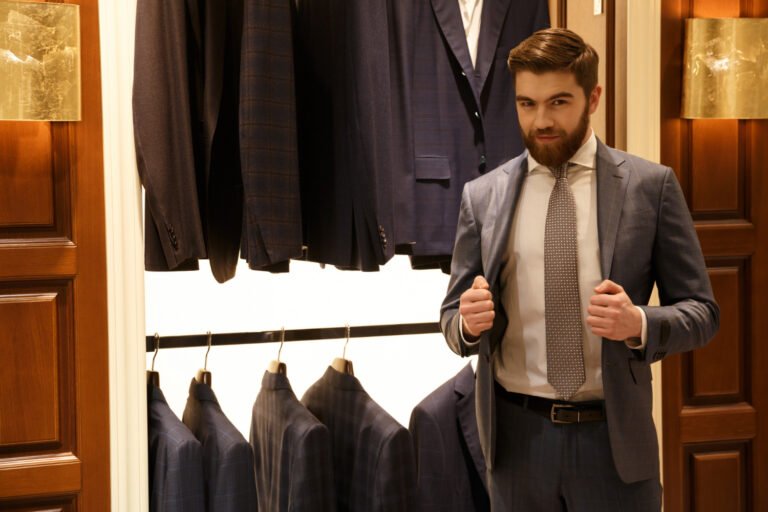
Throughout, the guiding principle is restraint. Nothing below is meant to be interesting or memorable — the goal in every case is an outfit that lets you be present for the people around you without anything you’re wearing becoming a distraction.
1. Charcoal Suit, White Shirt, Black Tie — The Standard Choice
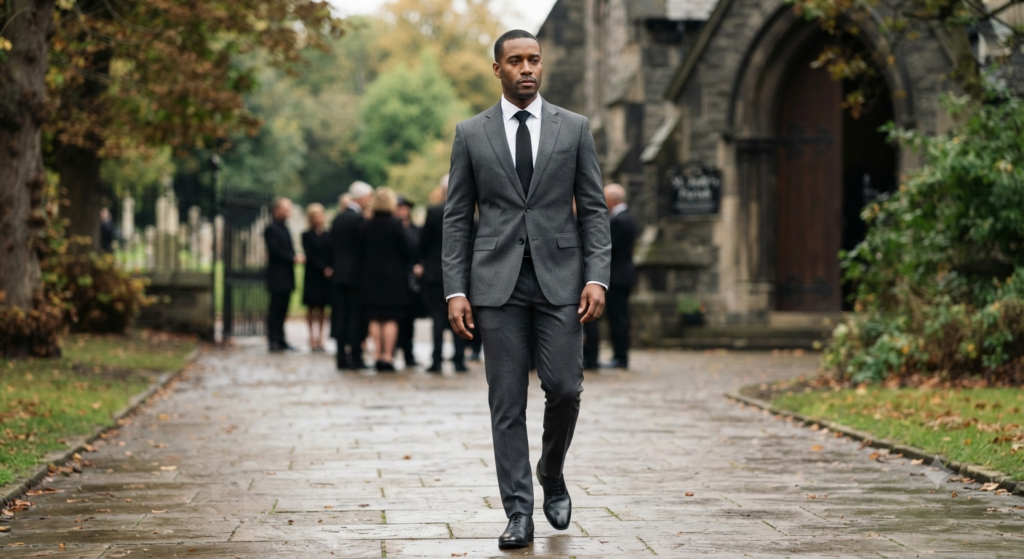
A charcoal suit with a plain white shirt and a solid black silk tie is the most broadly appropriate outfit for the majority of funerals, whether you’re an immediate family member or an acquaintance paying respects. Pair it with black leather oxfords and a matching black belt.
Charcoal is, in most contemporary settings, considered equally appropriate to true black and often more practical, since it’s a suit you likely already own and will use again for business or formal occasions. Keep the tie completely plain — no pattern, no texture play, nothing that draws the eye.
Appropriate for: most funeral services, wakes, and memorial gatherings, whether you’re close family or a more distant acquaintance.
2. Navy Suit, White Shirt, Black Tie — An Equally Appropriate Alternative
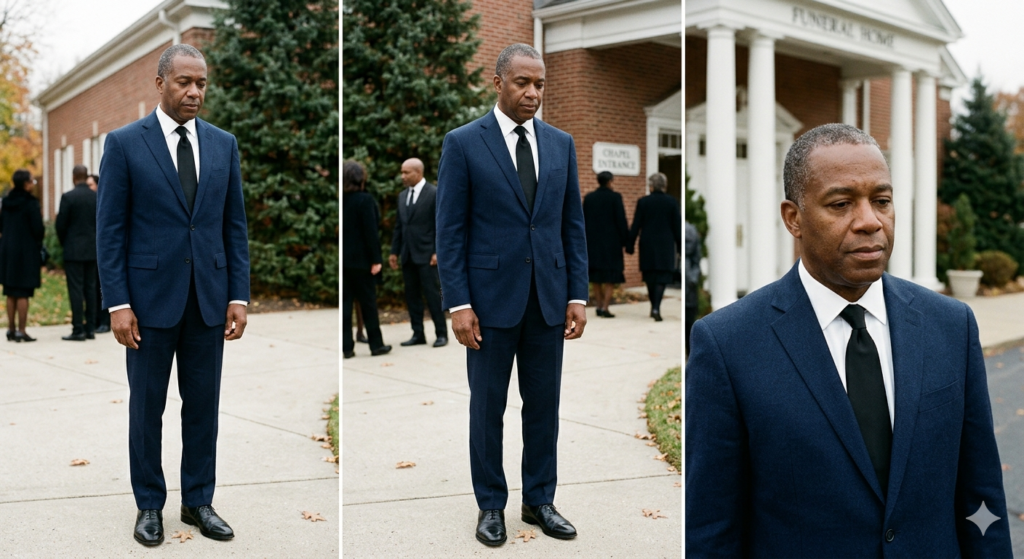
If charcoal isn’t in your wardrobe, a dark navy suit with a white shirt and black tie serves the same purpose and is broadly accepted at nearly all funeral services. Pair it with black shoes and a black belt, keeping the overall look as understated as the charcoal version above.
Some families and cultures do still expect strictly black attire, particularly for more formal or traditional services, so if you’re able to ask a family member or check the service details in advance, it’s worth doing so. Absent any specific guidance, Navy is a safe and respectful default.
Appropriate for: general funeral attendance where specific dress instructions haven’t been given.
3. Black Suit, White Shirt, Black Tie — Full Traditional Formality
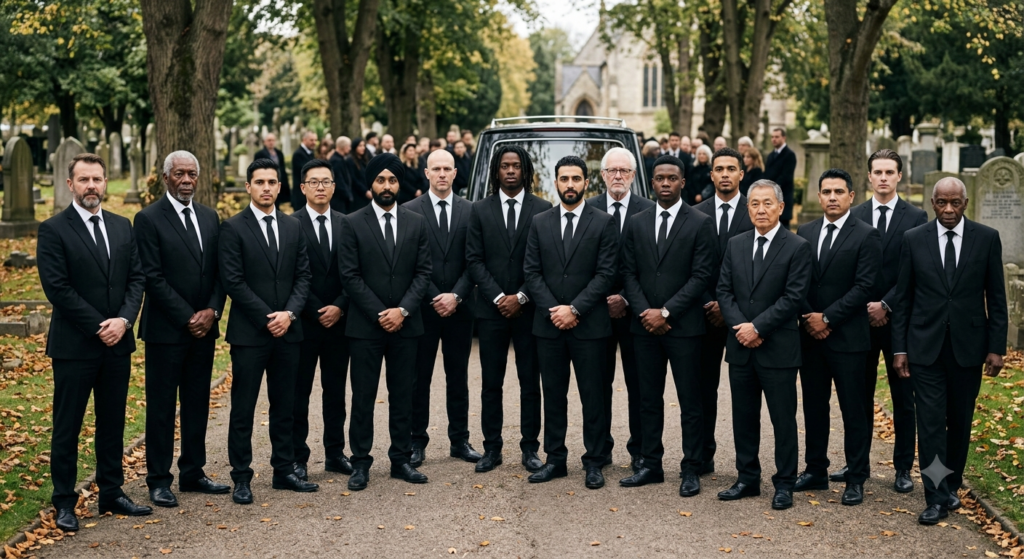
For funerals where strict, traditional formality is expected — particularly for pallbearers, close family members, or funerals following specific religious or cultural customs — a true black suit with a white shirt and black tie is the most conservative and universally accepted choice.
Pair it with polished black oxfords and no visible accessories beyond a simple watch.
This is the outfit to default to if you’re uncertain what a specific service calls for and want to be safe rather than risk under-formalizing the occasion. It communicates the same message everywhere: full respect, no distraction.
Appropriate for: pallbearers, immediate family, formal religious services, state or military funerals.
4. Dark Grey Suit, Pale Blue Shirt, Dark Navy Tie — A Softer Option for Distant Acquaintances

For funerals where you have a more distant connection to the deceased — a colleague’s family member, a neighbor, an extended acquaintance — a dark grey suit with a pale blue shirt and a dark navy tie is a slightly softer variation that still reads as fully appropriate and respectful. Pair it with black or very dark brown shoes.
This isn’t meant to be a departure from restraint, just a marginally gentler alternative to stark white and black for situations where you want to convey respect without appearing as though you’re part of the immediate mourning family. If in doubt about your specific role at a service, the charcoal-and-black combination in outfit #1 remains the safer universal choice.
Appropriate for: funerals for extended acquaintances, colleagues’ family members, and distant connections.
5. Navy Suit, White Shirt, No Tie — For Informal Memorial Services
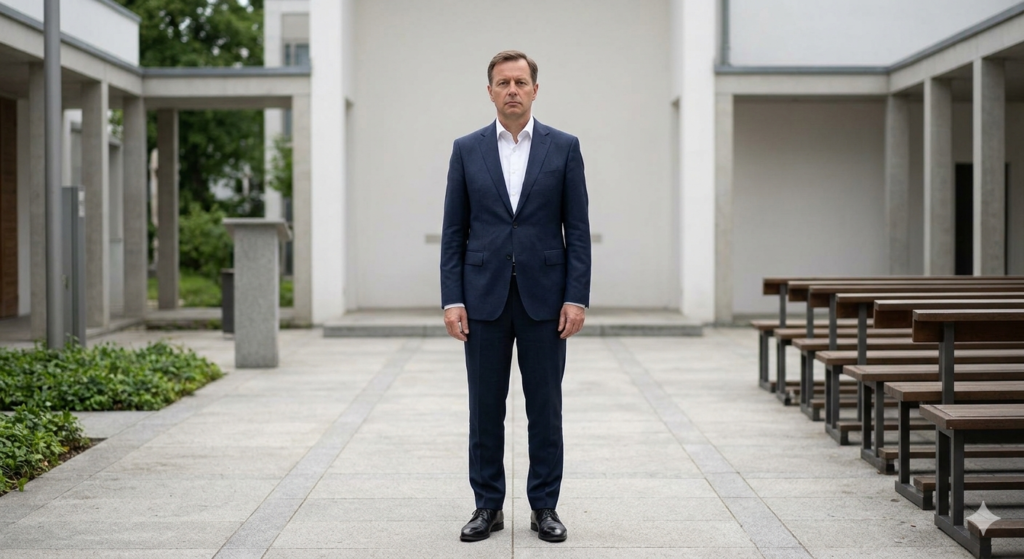
Some memorial services, particularly celebration-of-life gatherings held after a more private family funeral, explicitly request less formal dress. In these cases, a navy suit with a white shirt, top button open, and no tie is entirely appropriate, provided the invitation or family has indicated a relaxed dress expectation. Pair it with black or dark brown leather shoes.
Never assume a no-tie approach is appropriate without some signal that the specific service calls for it — a formal religious service or a traditional wake still generally expects a tie, and removing one without cause can read as underdressed for the occasion rather than appropriately relaxed.
Appropriate for: celebration-of-life events, informal memorial gatherings where relaxed dress has been indicated.
6. Lightweight Charcoal or Navy Suit for a Summer Funeral
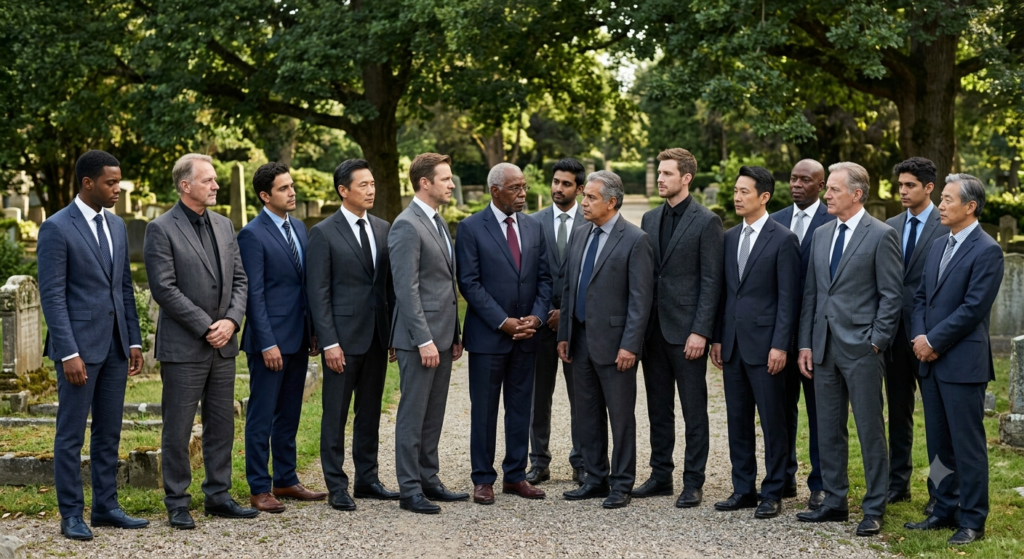
Summer funerals present a genuine practical challenge: full formality in extreme heat, particularly for outdoor services. A lightweight charcoal or navy suit (around 8-9 oz, sometimes in a wool-linen blend) with a white shirt and black tie maintains the appropriate level of formality while remaining wearable in genuine heat. Pair it with black leather shoes.
Avoid pure linen for a funeral specifically — its natural wrinkling and casual character read as too relaxed for the occasion, even in warm weather. A lightweight wool or wool-blend fabric holds its shape and formality far better while still offering real breathability.
Practical tip: carry a plain white handkerchief rather than a patterned pocket square if you need to manage heat or emotion during the service — function over styling in this specific context.
7. Suit for a Graveside Service — Practical Considerations for Outdoor Settings
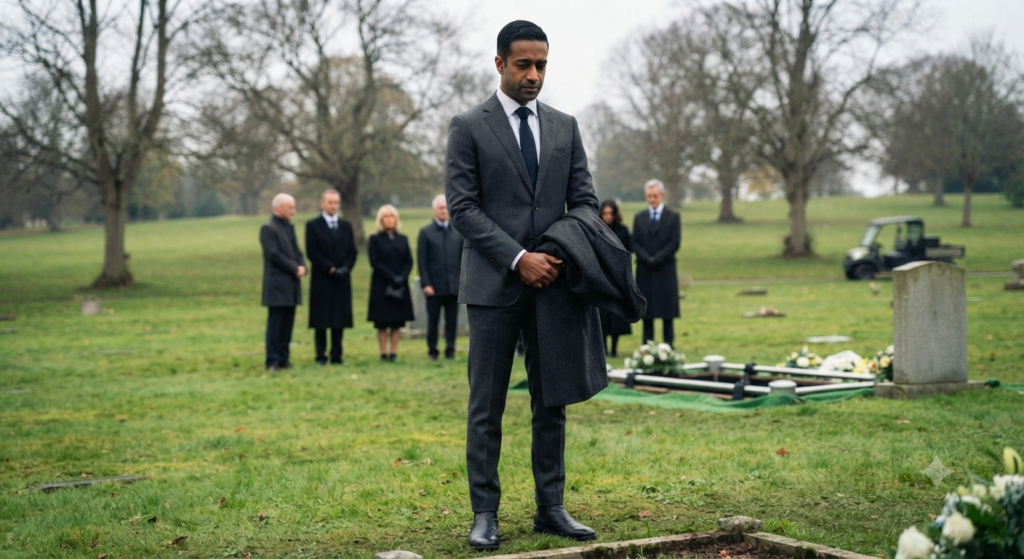
Graveside services introduce practical concerns beyond formality alone: uneven ground, potential mud or wet grass, and weather exposure. A charcoal or navy suit remains the right formal choice, but footwear deserves specific attention — a leather sole with reasonable traction is more practical than a highly polished dress shoe with a slick sole if the ground is uneven or wet.
A dark wool overcoat is worth bringing along regardless of season, since graveside services often run longer than expected and offer no indoor shelter from wind or temperature changes.
If rain is a possibility, a plain black umbrella is the appropriate accessory — patterned or brightly colored umbrellas stand out inappropriately at this kind of service.
Appropriate for: graveside burials, cemetery services, any funeral component held outdoors.
8. Suit and Overcoat for a Winter Funeral

For funerals held in cold weather, a charcoal or navy flannel suit under a dark wool overcoat (charcoal, navy, or black) maintains real warmth without sacrificing formality.
Pair it with black leather gloves and a plain black or dark grey scarf if needed — avoid anything patterned or brightly colored, since even a subtle plaid scarf can read as an unintentional departure from the day’s restraint.
Flannel’s heavier weight and matte finish are genuinely well-suited to this context beyond just warmth — the fabric’s subdued texture photographs and reads appropriately somber compared to a lighter-weight suit that might look slightly too crisp or business-appropriate for a winter memorial.
Appropriate for: winter funerals, cold-climate memorial services.
9. Suit for Delivering a Eulogy
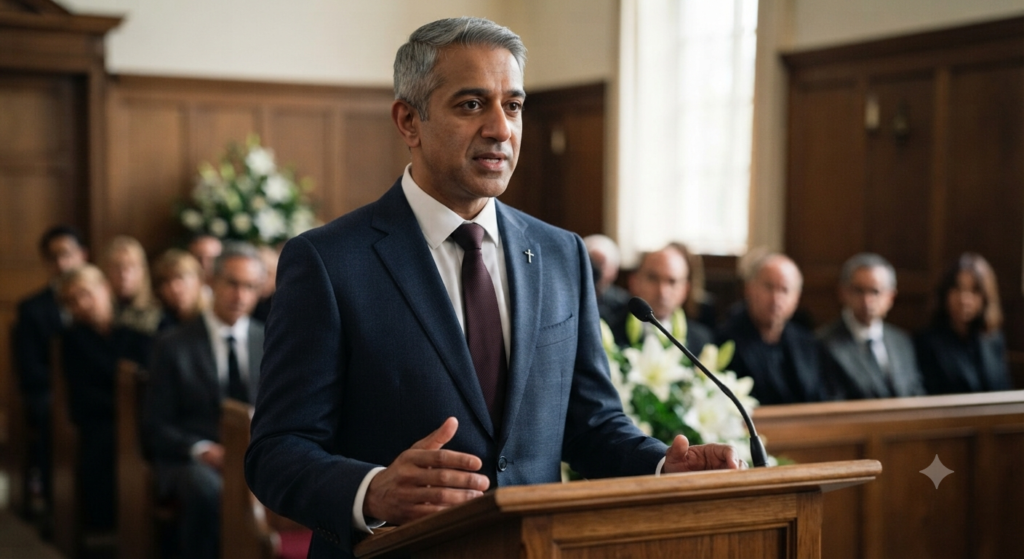
If you’re delivering a eulogy, the outfit should be entirely unremarkable so that all attention stays on what you’re saying rather than what you’re wearing.
A charcoal or black suit, white shirt, and black tie, with no pocket square, tie bar, or other decorative accessory, is the appropriate choice. Keep shoes polished but not glossy enough to catch light or attention under any venue lighting.
This is one funeral context where even small style choices that would otherwise be perfectly appropriate — a patterned tie, a colored pocket square — should be avoided specifically because you’ll be standing at the front of the room with everyone’s attention already on you.
Appropriate for: anyone delivering remarks, readings, or a eulogy during the service.
10. Suit for a Celebration of Life with a Personal Touch

Some families specifically request a small personal touch at a celebration of life — a subtle tie in the deceased’s favorite color, for instance, rather than requiring all black or fully somber dress throughout. In these cases, a charcoal or navy suit with a white shirt and a single tasteful accent — a tie in a specific requested color, kept solid or very subtly patterned — respects both the formality of the occasion and the family’s specific wishes.
Only take this approach if the family has explicitly indicated it’s welcome, either directly or through the invitation itself. Absent that guidance, default to the fully traditional combinations covered earlier in this guide.
Appropriate for: celebrations of life where the family has specifically requested a personal touch or departure from strict black-and-white formality.
Read also: Men’s Suit Guide: How to Get a Suit Tailored Correctly
11. Suit Etiquette for Catholic and Christian Funeral Masses
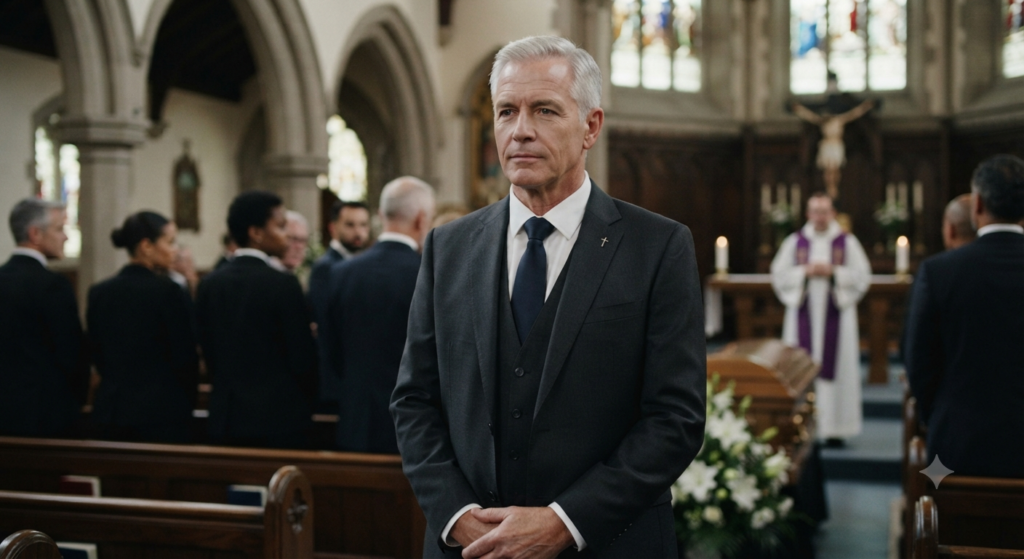
For a formal Catholic or other Christian funeral Mass, a dark suit — charcoal, navy, or black — with a white shirt and dark tie is appropriate, and no head covering or additional religious garment is expected of male attendees.
Keep the outfit conservative throughout the full service, including any accompanying reception, since these services often run for an extended period across multiple settings (church, graveside, reception).
If you’re a pallbearer specifically for a Catholic service, check with the funeral home or family in advance — some Catholic funerals still follow specific pallbearer dress traditions that go slightly beyond standard guest attire.
Appropriate for: Catholic and Christian funeral Masses and related services.
12. Suit Etiquette for a Jewish Funeral or Shiva
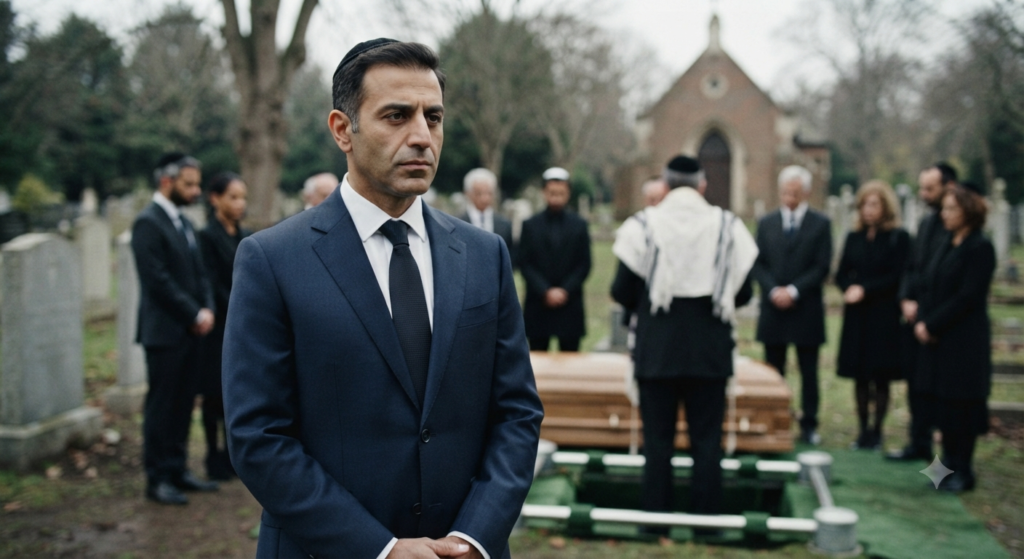
For a Jewish funeral service, a dark, conservative suit remains appropriate, but male attendees are generally expected to wear a head covering (a yarmulke or kippah) during the service itself — these are typically provided at the entrance if you don’t own one.
Dress remains formal and understated for the funeral service itself; for a shiva visit afterward, dress can be slightly less formal, though still respectful and subdued, since shiva is held in a mourning family’s home rather than a formal venue.
If you’re unsure of specific customs for a particular Jewish community or denomination, it’s entirely appropriate to ask a mutual friend or the funeral home directly — customs can vary meaningfully between different Jewish traditions.
Appropriate for: Jewish funeral services and related mourning periods.
13. Appropriate Attire for Funerals Following Non-Western Cultural Traditions
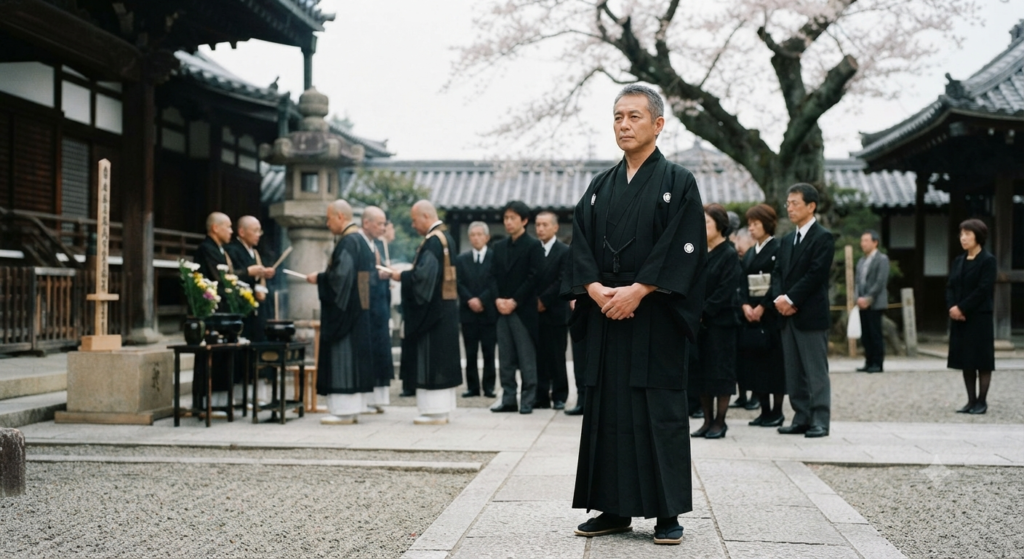
Not every culture treats black as the color of mourning. In several Hindu, Buddhist, and other Asian traditions, white is the traditional mourning color rather than black, and wearing black to some of these services can actually run contrary to custom.
If you’re attending a funeral rooted in a tradition you’re less familiar with, a simple, respectful question to a family member, friend, or the funeral home in advance is entirely appropriate and generally welcomed — better to ask than to assume Western conventions apply universally.
Where specific guidance isn’t available, a plain, conservative suit in a muted, non-black tone (grey, navy, or white, depending on what you’re able to confirm about the specific tradition) paired with minimal accessories is a reasonably safe default until you can get more specific direction.
Appropriate for: funerals following cultural or religious traditions where black may not be the expected mourning color.
14. A Simple First Suit for a Young Man Attending His First Funeral
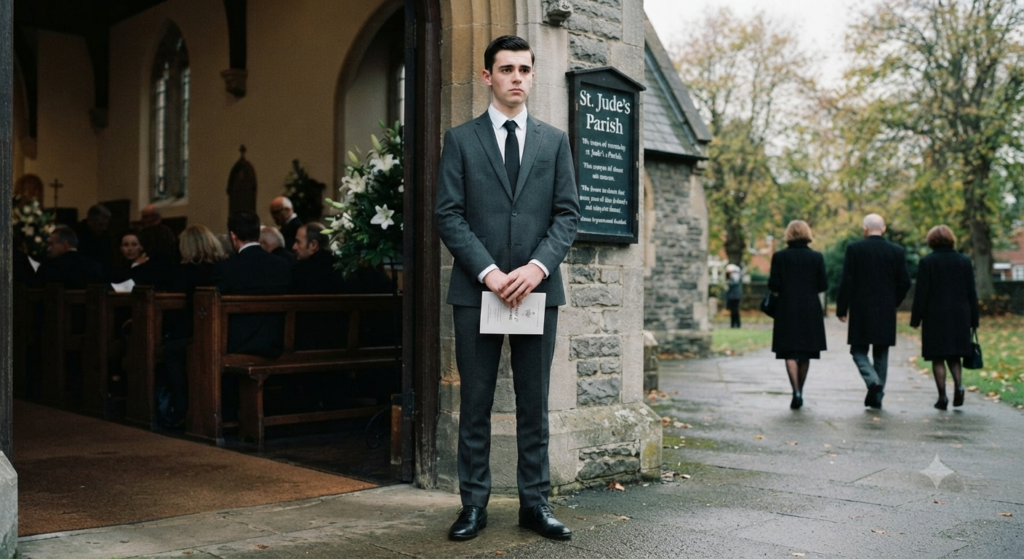
For a teenager or young man who doesn’t yet own a suit and is facing his first formal funeral, the goal is simplicity over investment — a well-fitted charcoal or navy suit from a mainstream retailer, tailored at minimal cost for the shoulders and trouser length, a white shirt, and a black tie will serve the occasion completely appropriately.
This doesn’t need to be an expensive purchase; it needs to fit reasonably well and follow the same restrained principles as every other outfit in this guide.
If a full suit purchase isn’t practical on short notice, dark trousers, a white dress shirt, a black tie, and a dark blazer (rather than a full matching suit) is an acceptable and respectful substitute — the goal is conservative, coordinated dark clothing, not a technically perfect matching suit.
Appropriate for: young men attending their first formal funeral without an existing suit in their wardrobe.
15. Suit for a Colleague’s Funeral or Memorial Service

Attending a coworker’s funeral, or the funeral of a colleague’s family member, calls for the same restrained principles as any other funeral, with one added consideration: you may see other colleagues or supervisors there, so professional-grade fit and presentation matter slightly more than at a purely personal or family funeral.
A charcoal or navy suit, white shirt, black or dark navy tie, and polished black shoes cover this appropriately.
Keep any conversation and behavior at the reception, if there is one, focused on genuine condolence rather than work matters — this isn’t the setting for networking, regardless of who else from the office happens to be present.
Appropriate for: funerals or memorial services connected to a workplace, whether for a colleague directly or a colleague’s family member.
Read also: 20 Suit Outfits for Men for a Job Interview
What to Avoid at a Funeral, Regardless of Which Outfit You Choose
A few things apply across every combination above. Avoid bright colors entirely, including bright ties, colored pocket squares beyond a plain white handkerchief, and patterned socks that might show when seated. Avoid anything with visible logos or branding, which reads as inappropriately casual or self-promotional for the setting.
Avoid sneakers or overly casual footwear even if the rest of your outfit is formal — shoes are one of the first things people notice, and a mismatch here undercuts an otherwise appropriate outfit.
And avoid heavy cologne, since funeral venues are often smaller, enclosed spaces where a strong scent can be genuinely distracting to people around you who may already be managing difficult emotions.
If you’re uncertain whether a specific detail is appropriate for a specific service, the safest approach is simply to ask a family member, a mutual friend, or the funeral home directly.
Nobody will think less of you for checking — it’s a far better outcome than guessing wrong on a day that isn’t about you.
If You Don’t Own a Suit and Can’t Buy One in Time
Not everyone has a suit on hand for an unexpected funeral, and there’s no shame in that. Dark trousers (navy, charcoal, or black), a white dress shirt, a black or dark tie, and a dark blazer or sport coat if you have one — or even just the shirt and trousers alone if a jacket isn’t available — will read as appropriately respectful.
What matters most is that the overall impression is dark, clean, and understated; a perfectly matched suit is far less important than showing up with genuine care taken over your appearance.
Frequently Asked Questions
Is black required, or is navy or charcoal acceptable? For most contemporary funerals, navy or charcoal is entirely acceptable and increasingly common. Some specific religious or cultural traditions, or specific family requests, may call for true black — when in doubt, ask, or default to black if no guidance is available.
Can I wear a patterned tie to a funeral? It’s safest to keep the tie completely solid. A very subtle, barely visible texture (like a knit tie) is sometimes acceptable, but anything with a visible pattern, stripe, or bold color should be avoided.
Is it appropriate to wear a tie bar or a pocket square? A tie bar is generally fine if it’s simple and unobtrusive — plain silver or black, nothing decorative. A pocket square should be plain white if worn at all; anything patterned or colored is better left at home.
What if the funeral invitation specifically says “celebration of life” rather than “funeral” — does that change the dress code? It can, but not automatically. Some celebrations of life are genuinely more relaxed and may even request specific colors or casual dress; others follow the same formal conventions as a traditional funeral. If the invitation doesn’t specify, it’s appropriate to ask the family or default to standard funeral formality.
Should I dress differently for a wake or viewing versus the funeral service itself? Generally, the same level of formality applies to both, though a wake or viewing held over multiple hours in a more casual setting sometimes allows slightly less formal dress than the funeral service itself. If you’re attending both, the outfit combinations in this guide work appropriately for either.
Is it acceptable to wear brown shoes instead of black to a funeral? Black is the safer and more traditional choice. Very dark brown can work in some more relaxed contemporary settings, but if you’re at all uncertain, black shoes remain the more universally appropriate option.
What should I wear to a funeral in extreme summer heat if I don’t own a lightweight suit? A standard-weight suit worn without an undershirt, with the jacket removed once you’re not in view of the main service (checking first whether that’s appropriate for the specific setting), is a reasonable compromise. Prioritize completing the formal portions of the service in full attire, and adjust for comfort afterward if the setting allows it.
Can I wear a suit I already own in a bold color, like burgundy or olive, if it’s the only suit I have? It’s better to avoid bold or unusual suit colors for a funeral, specifically, even if that’s your only suit. If a neutral charcoal, navy, or black suit isn’t available to you, dark trousers with a white shirt, black tie, and a dark blazer (borrowed if necessary) is a more appropriate substitute than a brightly colored suit.
Is it disrespectful to wear the same suit to multiple funeral-related events, like the viewing, service, and burial? Not at all — wearing the same appropriate outfit across a full day of connected events (viewing, service, graveside burial) is entirely normal and expected. There’s no requirement to change outfits between different components of the same day.
How formal should I dress if I’m attending virtually, via a livestreamed funeral service? The same principles of restraint and respect apply, even without an in-person audience. A dark, conservative shirt and tie at minimum is appropriate if you’re visible on camera; a full suit is a thoughtful gesture even when attending remotely, though understandably, some flexibility is reasonable given the circumstances.
A Final Note
There’s very little room for personal style at a funeral, and that’s exactly as it should be — the day belongs to the person being remembered and the people closest to them, not to what anyone else is wearing. If you take away one thing from this guide, let it be this: when in doubt, choose the more conservative, more restrained option every time. Nobody has ever been faulted for being slightly overdressed and quietly respectful at a funeral.
Read also: