15 Ways to Wear a Pink Suit (Without Looking Like You’re Trying Too Hard)

The first time a client of mine put on a pink suit, he stood in front of the mirror for a solid ten seconds before saying, “I don’t know if I can pull this off.” Six months later, that same suit was the one he reached for whenever he wanted to look sharp without looking like everyone else in the room.
That’s the thing about pink — it photographs as bold, but worn correctly, it reads as confident, not flashy.

The confusion around pink suits usually comes down to one thing: nobody explains what to pair it with. A navy suit is forgiving. Pink is not.
Get the shirt, tie, or shoe wrong, and you tip from “sharp” into “costume.” Get it right, and you’ve got one of the most versatile colors in modern menswear — light enough for summer, warm enough for a wedding, and unexpected enough to make people remember what you wore.
This guide breaks down fifteen ways to wear a pink suit, from boardroom-appropriate to full statement-piece territory. For each look, I’ll cover the shirt, tie (or lack of one), shoes, and accessories, along with the occasions where it works best and the mistakes that quietly ruin the whole outfit.
By the end, you should know exactly which version of “wearing pink” fits your life, your coloring, and your calendar.
A quick note before we start: not all pinks are the same. Dusty rose, salmon, blush, and a true bubblegum pink all behave differently. Most of the combinations below work across the lighter, more muted end of the spectrum — that’s the range that reads as sophisticated rather than novelty. If your suit leans closer to true fuchsia, size down the boldness of everything else you’re wearing.
1. White Shirt, Navy Tie — The Safest Entry Point

If you’ve never worn a pink suit before, start here. A crisp white dress shirt and a solid navy silk tie do the heavy lifting of making the pink jacket look intentional rather than experimental. Navy is the color equivalent of a firm handshake — it grounds the outfit immediately.
Keep the tie a plain weave or a subtle grenadine texture rather than anything patterned; the suit is already the statement piece, so the tie’s job is to support it, not compete. A white pocket square, folded into a simple straight edge rather than a fussy puff, finishes the chest without adding more color into the mix.
For shoes, go with a dark brown or oxblood leather oxford. Black shoes with a pink suit can look slightly funereal; brown warms the whole outfit up and matches the general tone of “confident, not costume.” A brown leather belt to match the shoes, and a simple stainless or gold-toned watch, round things out.
This combination works for client meetings, first-round interviews at less conservative companies, and any office where you want to be memorable without raising eyebrows.
The common mistake here is going too tight through the jacket — pink already draws the eye, and if the fit is off, people notice the fit before they notice the color was even a good choice. A jacket that closes cleanly with one button, without pulling across the chest, is non-negotiable.
2. Open-Collar White Shirt, No Tie — Daytime Wedding Guest
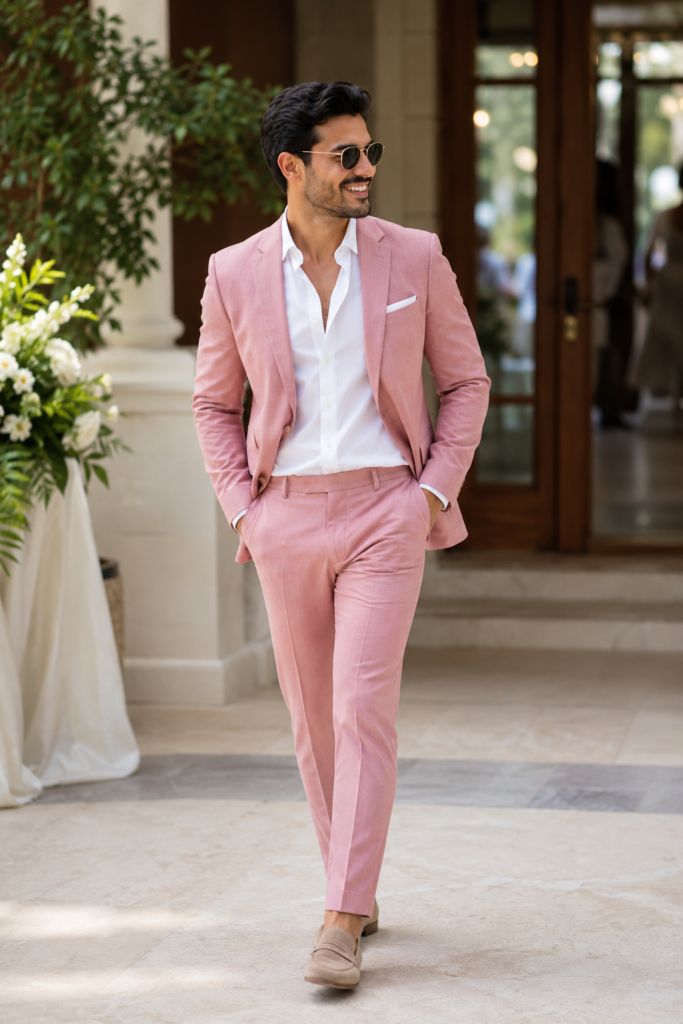
Drop the tie, unbutton the top collar button, and you’ve moved this same suit from the office into daytime wedding territory. This is one of the most requested pink suit looks I get asked about, mostly because it manages to look put-together without any of the stiffness of a full tie-and-jacket combination.
The shirt still needs to be a proper dress shirt — a soft spread collar holds its shape better without a tie than a button-down does, which tends to look a little floppy when it’s not anchored by a knot. Skip the pocket square here; with an open collar, the look already has enough going on, and an unstructured chest keeps things relaxed rather than half-dressed-up.
Loafers, not oxfords, are the move. A penny loafer or a simple slip-on in tan or chestnut suede feels appropriate for a daytime, likely outdoor, event. No socks or low-cut socks, depending on the season. A leather-strap or fabric NATO watch band suits this more casual register better than a metal bracelet would.
This look is built for garden weddings, brunches, and daytime cocktail events between spring and early fall. One thing to watch: with no tie and an open collar, the suit’s fit around the neck and shoulders becomes the whole story. If the collar gaps or the shoulders are too broad, there’s nothing else in the outfit to distract from it, so this is a look where a proper tailoring check really pays off.
3. Pale Blue Shirt, Burgundy Tie — The Presentation Look
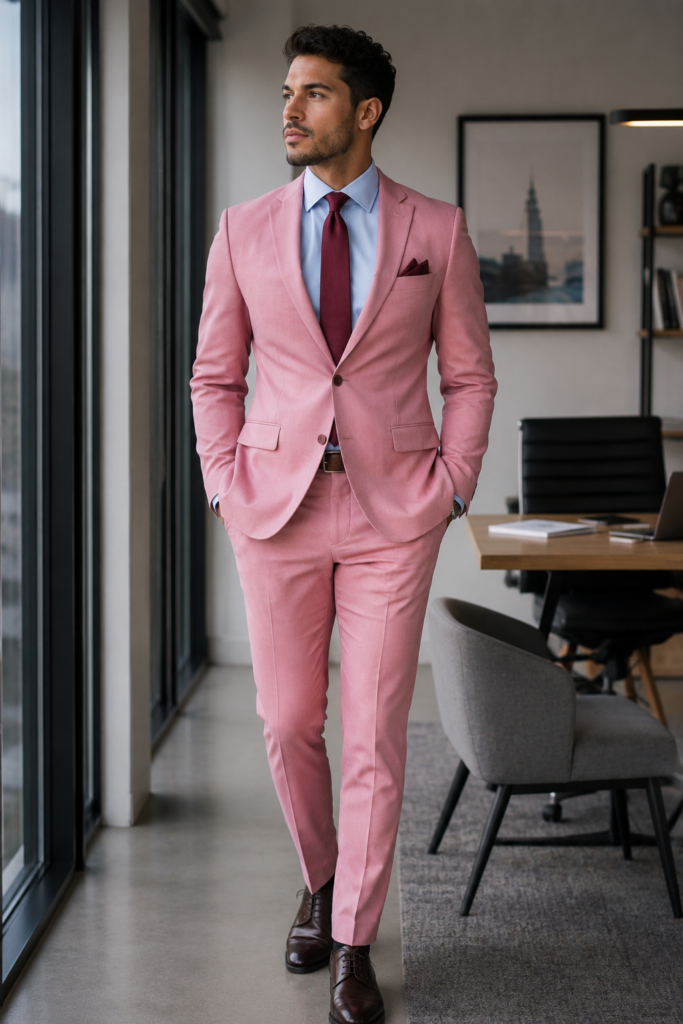
Pink and pale blue sit next to each other on the color wheel in a way that reads as coordinated rather than matchy. Swap the white shirt for a pale blue one, and the whole outfit gets a touch more depth — it’s a slightly more advanced pairing than white, but still very safe.
A burgundy or deep wine tie is the key here. It pulls warmth from the pink without repeating it exactly, and it reads as more distinctive than navy without being risky.
If you want a small additional detail, a burgundy-and-white pocket square (rather than solid burgundy) keeps the chest from looking too matched to the tie — you never want the tie and pocket square to be the exact same fabric or color; it looks like a boxed set rather than something you assembled yourself.
Read also: 20 Suit Outfits for Men Over 40
Black cap-toe oxfords actually work in this version, since the cooler blue shirt and deep burgundy tie shift the whole palette toward something more formal. A black belt to match, and if you wear a watch, a black or brown leather strap, depending on which shoe color you land on.
This is your suit for presentations, panel discussions, or any semi-formal business setting where you want to look considered rather than conservative. The mistake to avoid: don’t let the blue shirt be too saturated. A true sky blue or French blue will compete with the pink for attention. Look for a shirt that’s closer to a whisper of blue — almost white with a cool cast.
4. Gingham Shirt, No Tie — Garden Party and Summer Casual
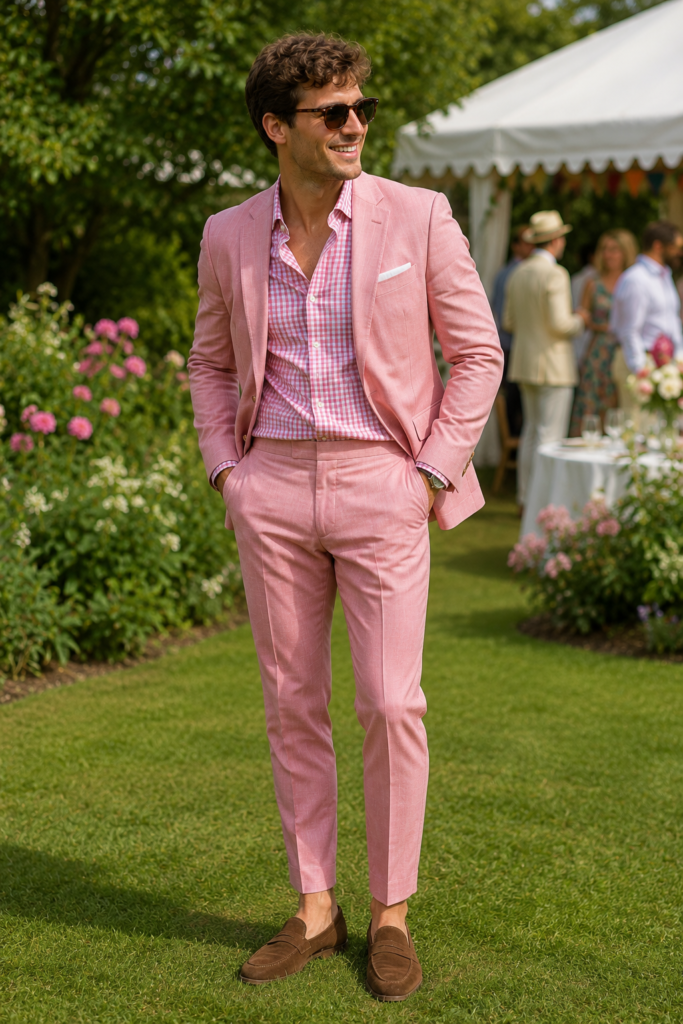
A small-scale gingham shirt in blue or pink-adjacent tones turns this suit into something that feels distinctly warm-weather and unbothered. This is the look for outdoor daytime events where you want to look like you dressed with care but didn’t overthink it — which, ironically, takes more thought than it looks.
Keep the gingham check small; a large-scale check next to a solid pink jacket creates visual noise that fights with the suit rather than complementing it. No tie, no pocket square — let the pattern be the only “extra” element in the outfit.
Suede loafers or woven leather slip-ons in a light tan color complete the summer feel. Skip the belt if you can get away with a beltless trouser (many suit trousers built for this kind of casual pairing have side adjusters instead), which keeps the waistline clean when the jacket comes off, since this is exactly the kind of outfit where the jacket comes off within the first hour.
This works beautifully for garden parties, summer rehearsal dinners, and daytime outdoor weddings. A common misstep: pairing a heavy wool suit with a gingham cotton shirt. The whole point of this combination is a lightweight, breathable feel — a cotton-linen blend suit fabric matches the casual energy of the shirt far better than a structured worsted wool would.
5. White Shirt, Navy Knit Tie — Cocktail Hour
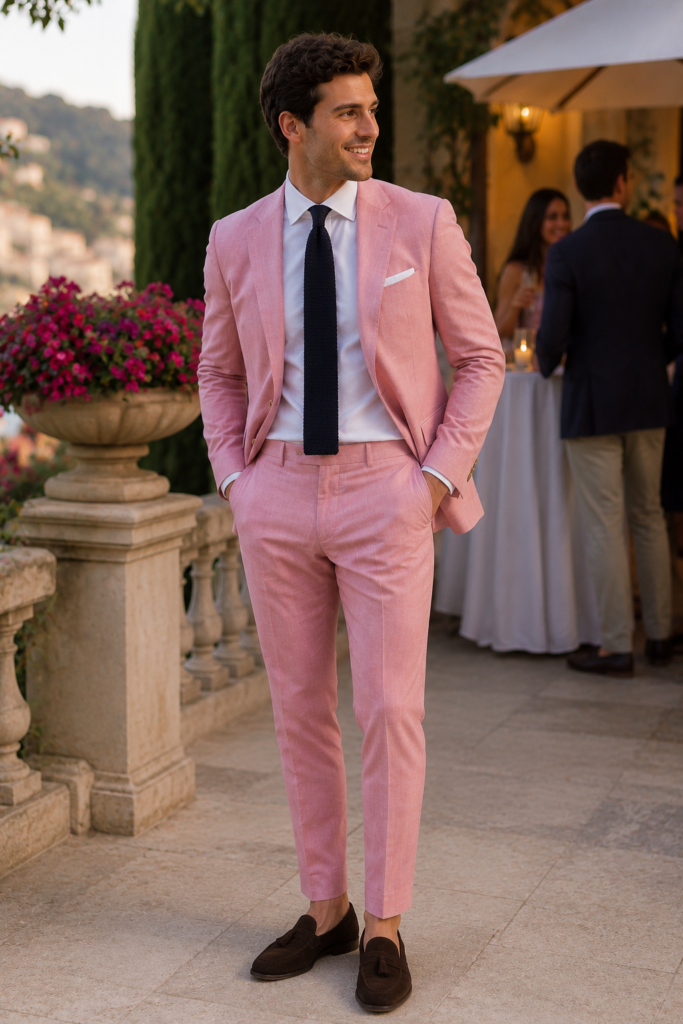
A knit tie is one of the most underused tools in a well-dressed man’s wardrobe, and it’s particularly good with a pink suit because its flat, matte texture contrasts nicely against pink’s smoothness. Pair it with a plain white shirt, and you get a look that’s dressier than the open-collar version but more relaxed than a full silk tie.
The blunt, squared-off end of a knit tie also reads as slightly less corporate than a pointed silk tie, which makes this pairing feel right for cocktail parties, engagement parties, and evening events that fall short of black tie but still expect a jacket.
Suede monk-strap shoes in a mid-brown tone add a bit of texture that echoes the knit tie without matching it outright — texture matching, rather than exact color matching, is a trick worth remembering any time you’re building an outfit with more than one textured element. A simple leather-strap watch and a brown belt finish things.
The mistake people make with knit ties is treating them like silk ties and tying a large, thick knot. A knit tie should be tied in a smaller four-in-hand knot, because the fabric itself has more bulk than silk, a bigger knot ends up looking clumsy rather than deliberate.
6. Black Turtleneck, No Shirt Collar — Evening Dinner
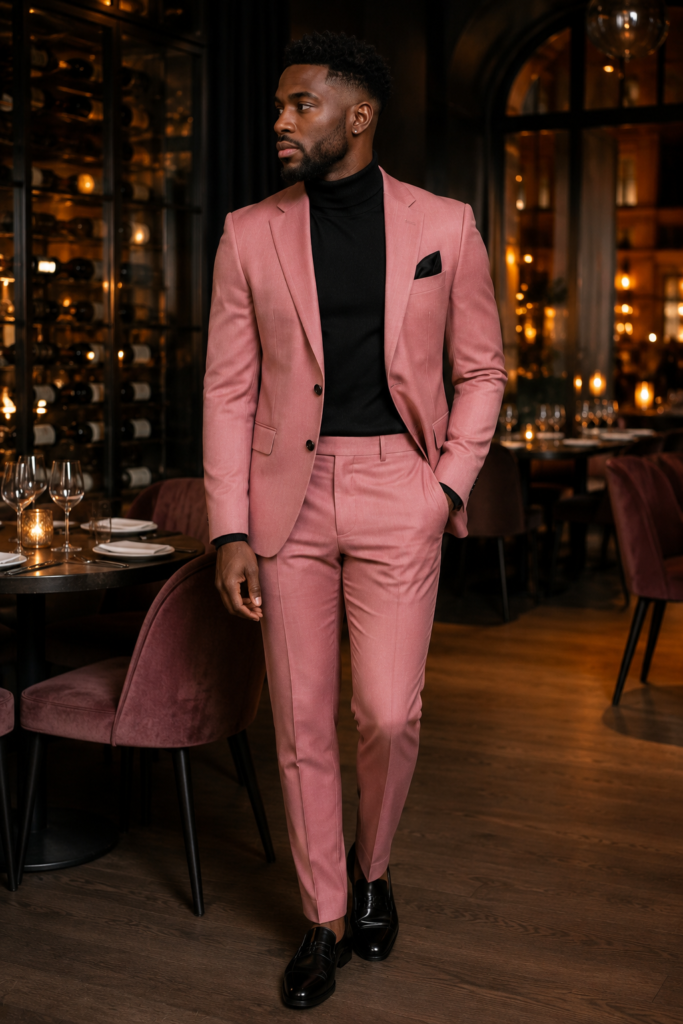
This is where a pink suit starts to feel genuinely modern. Swap the dress shirt for a fine-gauge black turtleneck (merino wool or a wool-cotton blend, never anything bulky), and you get a moody, editorial contrast that works exceptionally well for fall and winter evenings.
There’s no tie or pocket square in this version — the turtleneck’s clean neckline is the whole point, and adding anything else around the collar undoes the effect. This is a look built on contrast and simplicity rather than layered detail.
Black leather Chelsea boots are the natural footwear choice here, continuing the dark, sleek line from the turtleneck down. A black belt if your trousers need one, though many turtleneck-and-suit outfits skip the belt entirely to keep the silhouette as streamlined as possible.
This combination is built for dinner, a late gallery opening, or any evening event where black tie feels like overkill but you still want to look deliberately put-together. One real risk here: a heavyweight, chunky turtleneck will bulk up your neckline and throw off the suit’s proportions. Look for something genuinely thin — you should be able to see the shape of your collarbone through the fabric, not a rolled mass of wool.
7. Denim Shirt — Casual Weekend and Rehearsal Dinners

A chambray or lightly faded denim shirt worn under a pink suit jacket takes the whole outfit into off-duty territory while keeping enough structure that it still reads as “dressed.” This is a favorite of mine for rehearsal dinners and casual Friday events where a full suit-and-tie look would be overkill.
No tie here, and the top button stays open. If you want texture on the chest, a simple linen pocket square in white or a light neutral works better than anything patterned — the denim shirt is already doing pattern-adjacent work through its texture.
White leather sneakers, clean and minimal (avoid chunky soles or heavy branding), bring the whole look down a notch into genuinely casual territory. This is one of the few combinations on this list where sneakers, not loafers or oxfords, are the right call.
This works for casual rehearsal dinners, relaxed Friday offices, and daytime social events where suits are optional but you want to wear one anyway. The mistake to avoid: pairing a dark, heavily faded denim shirt with the suit. A lighter chambray reads as a deliberate style choice; a dark, obviously “jeans material” shirt reads as though you grabbed the wrong top by accident.
Read also: Linen Suit Outfits for Men: 12 Summer Ideas
8. Pink Blazer with Grey Trousers — Suit as Separates
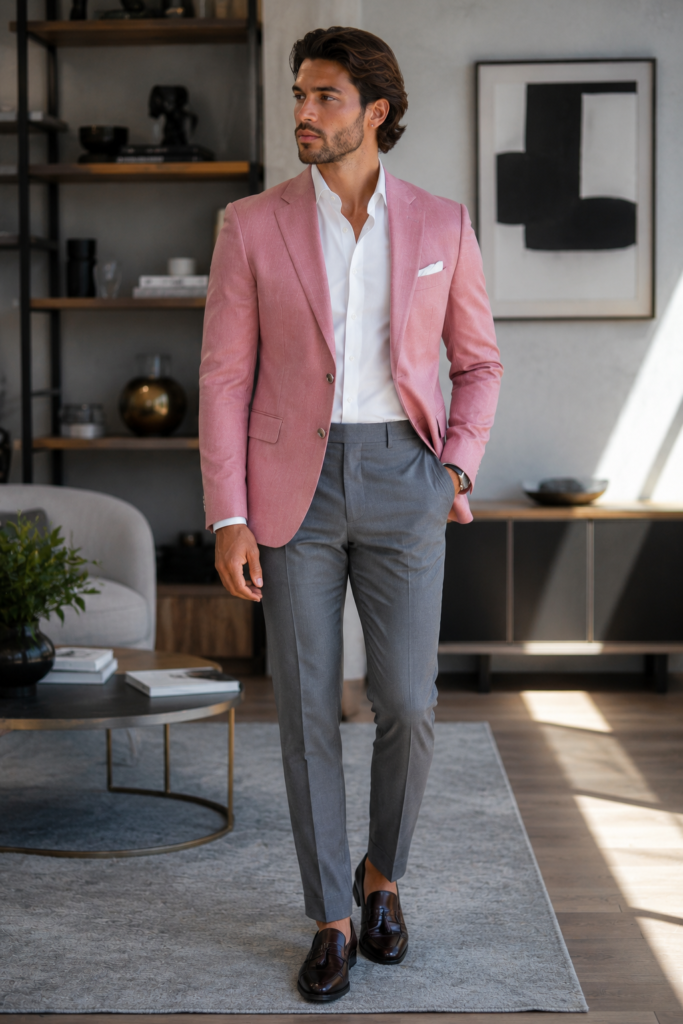
Not every pink suit has to be worn as a suit. Splitting it — pink jacket, contrasting grey wool trousers — is a smart move for building more mileage out of one purchase, and it also softens the overall boldness of the pink, since it’s no longer covering your whole lower body too.
A light blue or white shirt keeps this combination office-appropriate, and a tie is optional depending on how formal your workplace is. If you do add one, a small-patterned navy or grey tie continues the toned-down palette established by the trousers.
Black or dark brown oxfords work here since the grey trousers shift the outfit’s formality register closer to traditional business wear. A matching leather belt, and if you’re skipping the tie, consider a pocket square as the one accent color to keep the outfit from feeling flat.
This is ideal for offices that allow separates, client-facing roles where you want a memorable but still professional presence, and any situation where you’d rather not commit to wearing the full pink suit head-to-toe.
One important note on fit: a jacket built as part of a suit is cut to match its own trousers’ rise and proportions, so when you separate the pieces, make sure the jacket length still balances against whatever trousers you’re pairing it with — a jacket that was fine over its matching trousers can suddenly look too long or too short over a different pair.
9. Pink Trousers, Navy Blazer — The Reverse Pairing

Flip the separates approach, and you get an entirely different outfit: pink trousers under a navy blazer. This is a subtler way to wear pink if you’re not ready to put it across your chest and shoulders — the color shows up below the waist instead, which reads as more understated even though, technically, it’s the same amount of pink fabric.
A white or pale blue shirt keeps things classic underneath the navy blazer, and a tie is very much optional — this combination looks equally good dressed up with a silk tie for a slightly more formal event or left open for a smart-casual one.
Brown suede loafers work well here, striking a balance between the trousers’ casual pink and the blazer’s more traditional navy. A brown belt, and a watch with a brown leather strap tie the lower and upper halves of the outfit together.
This is a strong option for men who want to experiment with pink without wearing a full pink jacket, and it works for everything from smart-casual offices to daytime social events.
The common mistake: choosing trousers that are too slim or too baggy. Pink trousers, more than most colors, benefit from a clean, tapered leg — anything too loose reads as pajama-adjacent, and anything too tight draws unwanted attention to the fit rather than the color choice.
10. Striped Shirt, Silk Pocket Square — Cocktail Party
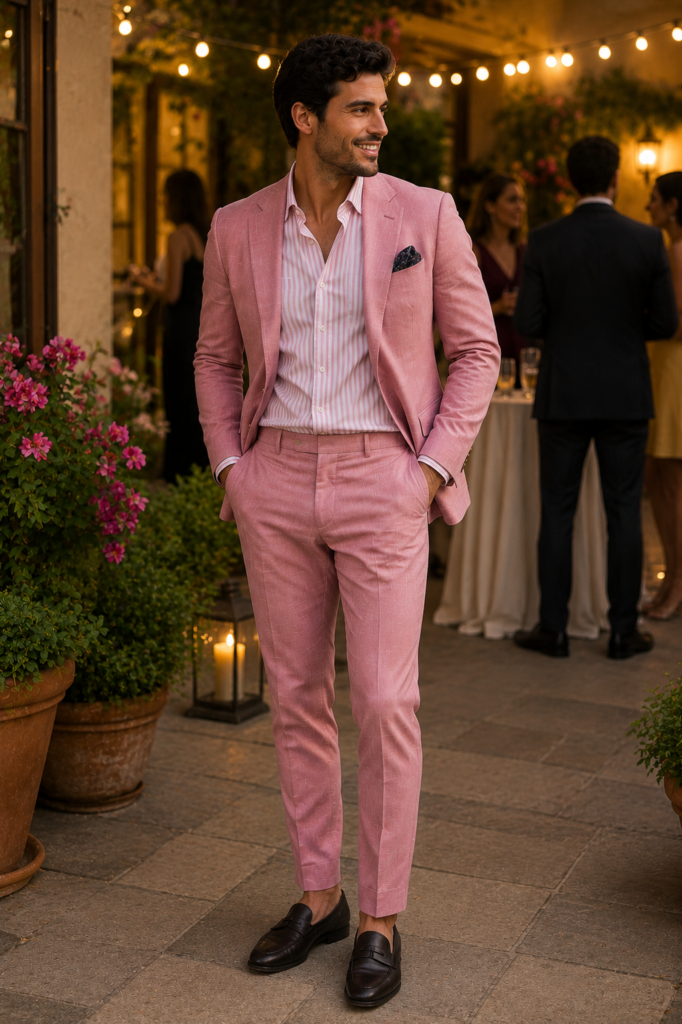
For a cocktail party where you want to look distinctly dressed-up rather than office-appropriate, a fine-striped shirt (thin navy or burgundy stripes on white) paired with a textured silk pocket square in a complementary color adds personality without a tie muddying the neckline.
Since you’re skipping the tie, the top collar button stays open, and the pocket square becomes the outfit’s main accessory — fold it with a bit more flourish here than in the more conservative looks earlier in this list; a puff fold or a three-point fold with visible texture suits the more festive setting.
Velvet loafers, in navy or burgundy, are an excellent choice for this kind of evening event — they read as dressier than suede without tipping into full formal-shoe territory. A slim leather belt and a dress watch (metal bracelet or a slim leather strap) complete things.
This combination is built for cocktail parties, holiday events, and evening social gatherings where the dress code sits between smart casual and semi-formal.
The mistake to sidestep: choosing a pocket square in the exact same stripe pattern as the shirt. Complementary, not matching, is the rule — a solid pocket square in a color pulled from the shirt’s stripe, rather than a mini version of the same pattern, looks considered instead of coordinated from a box set.
11. White Linen Shirt — Summer Wedding in a Warm Climate
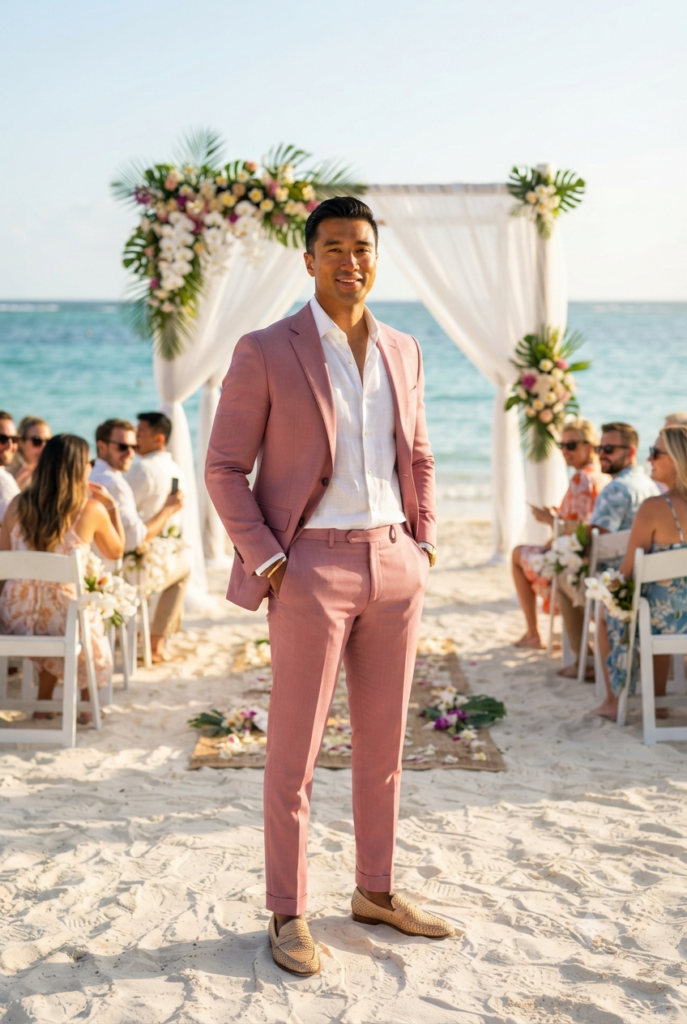
For destination or warm-climate summer weddings, swap your suit’s usual dress shirt for one in linen or a linen-cotton blend. Linen’s natural texture and slight looseness pair beautifully with pink, softening the color’s boldness and matching the relaxed, breathable feel the occasion calls for.
Skip the tie entirely in genuinely hot climates — this is a look built around comfort as much as style. A linen pocket square, left unstructured rather than pressed into sharp folds, continues the textural theme.
Woven leather sandals or breathable loafers without socks suit the climate best; this is one of the rare pink suit combinations where full formality genuinely isn’t the goal. A fabric or leather-strap watch, nothing heavy or metallic, that will feel uncomfortable in the heat.
This look is designed specifically for destination weddings, beachside ceremonies, and any event where the venue and climate call for genuine breathability over formality.
If the suit itself isn’t in linen or a linen blend, this combination will feel mismatched — a heavy wool suit jacket over a linen shirt looks like you’re fighting the weather rather than dressing for it, so ideally the whole outfit, not just the shirt, is built from lightweight, breathable cloth.
Read also: Men’s Suit Guide for Short Guys
12. Black Tie Accents — Semi-Formal Evening Event
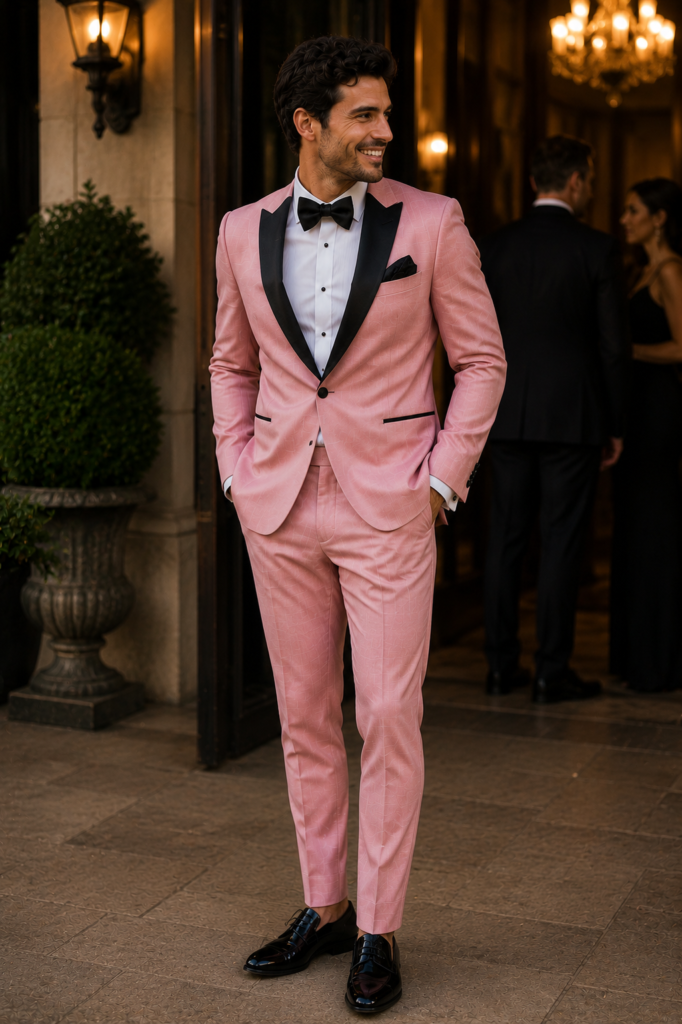
Pink isn’t a traditional black-tie color, and I wouldn’t recommend it for an actual black-tie event, but for a semi-formal evening — think an upscale dinner or an invitation that says “cocktail attire” — you can borrow a few black-tie details to elevate the pink suit into something more evening-appropriate.
A crisp white shirt, a black silk tie (not a bow tie — save that for the next look), and a black silk pocket square create a sharp, high-contrast frame around the pink. This combination leans more formal and more serious than most of the other looks on this list, which makes it well-suited to evenings where you want real polish.
Black patent or high-shine leather oxfords match the borrowed black-tie energy, along with a black leather belt and a dress watch on a black strap. Keep everything else understated — cufflinks, if you wear them, should be simple and metallic rather than colorful or novelty.
This works for upscale dinners, award ceremonies with a “cocktail attire” dress code, and evening events one notch below true black tie.
The mistake to avoid: don’t reach for a black bow tie here and call it black tie — a pink suit is not a substitute for a proper black or midnight-blue dinner jacket, and trying to make it pass as one usually reads as a miscalculation rather than a bold choice.
13. Polo Shirt — Resort and Vacation Casual
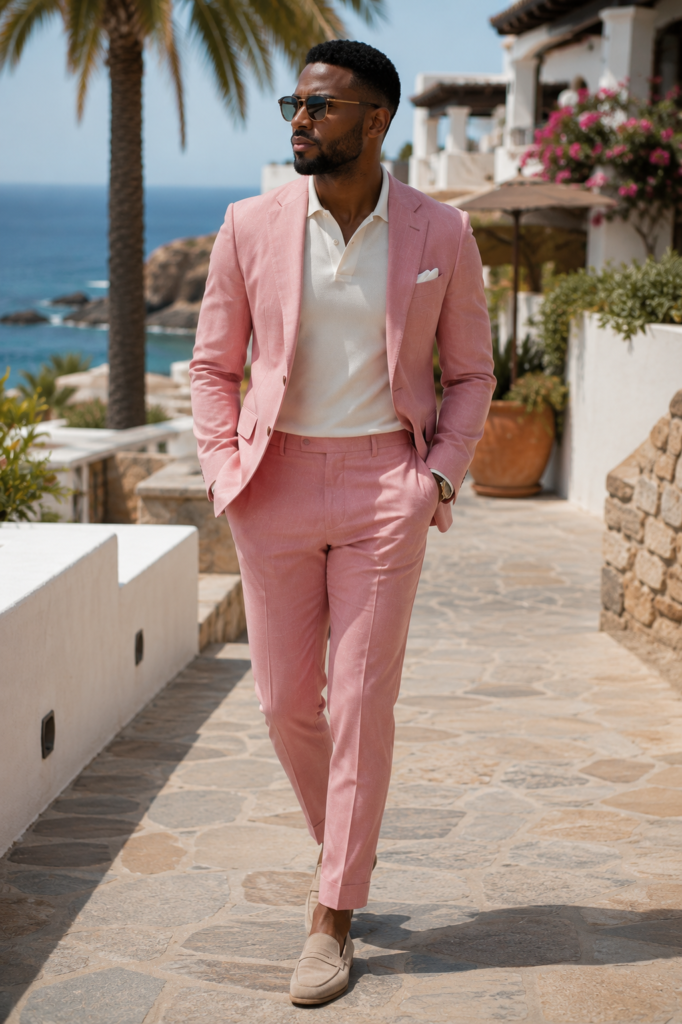
For genuinely relaxed settings — a resort dinner, a daytime vacation event, a country club lunch — a well-fitted polo shirt underneath a pink suit jacket (worn without trousers matching, or with the trousers rolled slightly at the ankle) creates an easy, warm-weather look that still has structure.
Choose a polo in white, navy, or a neutral that doesn’t compete with the pink — solid colors work far better here than striped or logo-heavy polos, which add visual clutter the outfit doesn’t need.
Boat shoes or woven espadrilles suit this setting far better than leather dress shoes, and this is one of the few looks on this list where going sockless is expected rather than optional. Leave the belt off if your trousers allow it; a drawstring or elastic-waist linen trousers paired with the jacket keeps the whole thing feeling intentionally undone.
This combination is for resort settings, vacation dinners, and country-club-adjacent events where a full suit would feel out of place but a blazer alone wouldn’t feel special enough.
The mistake to watch for: wearing this exact combination somewhere more formal than intended. A polo shirt under a suit jacket reads as “vacation,” and no amount of good tailoring changes that context — save it for settings where that’s actually the goal.
14. Bow Tie — The Statement Look
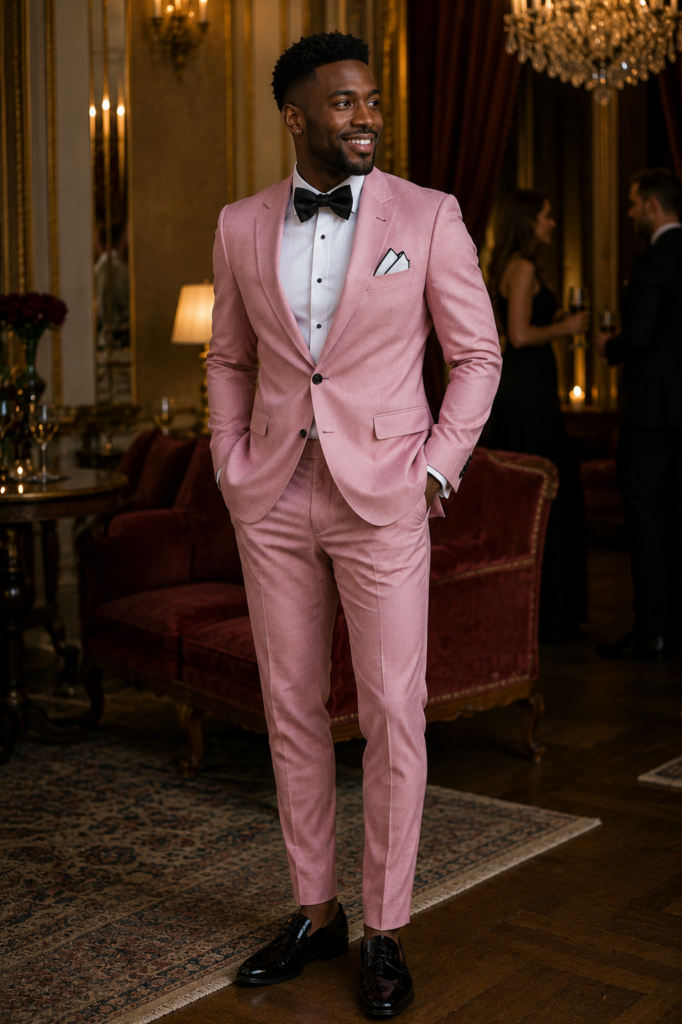
If you want your pink suit to be the memorable outfit at an event — a milestone birthday, an engagement party, a wedding where you’re not in the immediate wedding party but still want to stand out — a bow tie is the move.
Choose a solid black or a deep burgundy velvet bow tie rather than a novelty pattern; the suit itself is already the bold choice, so the bow tie’s job is to support that boldness with confidence, not add more competing patterns.
A white shirt with a spread collar (bow ties need a collar with enough room to sit properly underneath the knot) and a matching pocket square in black or burgundy ties the whole look together.
Black velvet slippers or polished leather oxfords both work here, depending on how formal the event is. A slim black or burgundy leather belt, and if you wear a boutonniere, a small, single-flower option keeps things from tipping into costume territory.
This is your suit for milestone events and parties where you genuinely want to be remembered. The mistake I see most with bow ties: a knot that’s too large or too perfectly symmetrical. A slightly imperfect, hand-tied bow (not a pre-tied clip-on) always looks more intentional and less like a costume piece.
15. Sweater Vest — Fall and Winter Transitional Office Look
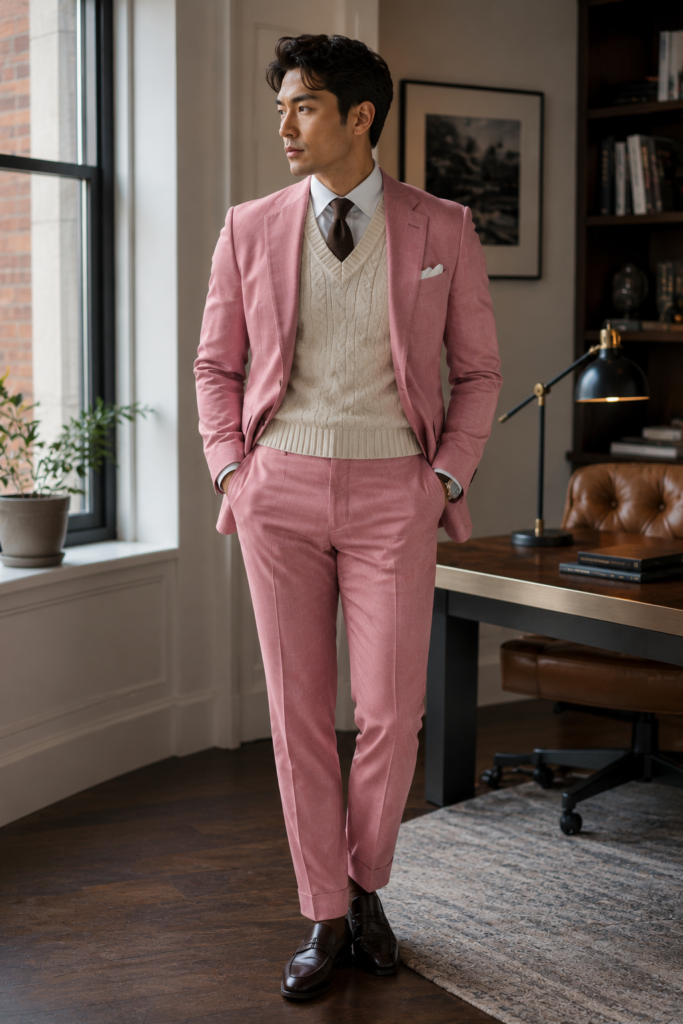
For the colder months, layer a fine-gauge sweater vest — navy, charcoal, or burgundy — over a white or pale blue dress shirt, underneath the pink suit jacket.
This adds warmth and texture without bulking up the silhouette the way a full sweater would, and it gives the outfit a slightly academic, tweedy energy that pairs surprisingly well with pink.
A tie is optional under the vest; if you include one, keep it slim and let it peek out cleanly rather than getting lost under the vest’s V-neck. Skip the pocket square in this version — between the vest, shirt, and jacket, the outfit already has enough layers of detail.
Brown leather brogues or wingtips complement the more textured, seasonal feel of this outfit, along with a brown belt and a leather-strap watch. If your pink suit is a heavier flannel or wool-flannel blend rather than a lightweight summer cloth, this is exactly the combination that puts that heavier fabric to good use.
This works well for fall and winter office settings, especially in industries with a bit more personality in the dress code, like design, media, or academia. The mistake to avoid: choosing a sweater vest that’s too thick or too long. It should sit neatly under the jacket without adding visible bulk at the waist or peeking out past the jacket’s hem.
Getting the Fit Right, No Matter Which Look You Choose
Every combination above depends on one thing more than any shirt, tie, or shoe choice: the suit actually fitting you. A pink suit that’s too big reads as a costume someone borrowed; one that’s too tight reads as trying too hard, no matter how good the color pairing is.
The shoulders are the foundation — the seam should sit right at the edge of your shoulder bone, not drooping past it or pulling inward. If the shoulders are wrong, no tailor can fix that affordably; everything else on this list is easier and cheaper to adjust.
Sleeve length should land right at the wrist bone, showing about a half-inch of shirt cuff. Jacket length, as a rough guide, should cover your seat without extending much past it — cupping your hand at your side, your fingers should roughly meet the jacket’s hem.
Trousers, for most of the looks above, look best with a slight break or no break at all; pink suits, more than most colors, benefit from a cleaner, more tapered leg than a heavy break allows.
Fabric Choices Worth Knowing
Pink suits show up most often in lighter-weight cloths, and for good reason — heavier fabrics can make the color feel dense and overwhelming rather than fresh. A tropical wool or wool-linen blend gives you structure with breathability, which is why it works for most of the business-adjacent looks above.
Pure linen or a linen-cotton blend, as mentioned in the summer wedding look, wrinkles more but breathes better, making it ideal for genuinely hot settings. Cotton suits hold their color especially well and offer a slightly more casual, matte finish than wool.
If you’re building toward a fall or winter pink suit, a flannel or wool-flannel blend adds enough weight and texture to justify pairing it with the sweater vest or turtleneck looks — a summer-weight pink suit worn in cold weather will always look slightly out of season, regardless of how you style it.
Building Toward a Wardrobe, Not Just One Suit
If a pink suit is your first foray beyond navy and grey, resist the urge to buy several pink pieces at once. One good pink suit, worn six or seven different ways using the combinations above, gets you more genuine use than three lower-quality pink pieces that all look similar.
Once you’ve worn it enough to know which two or three looks you reach for most, that’s the signal for what to invest in next — better shoes in the tone you keep gravitating toward, or a proper silk knit tie if you noticed you keep borrowing one.
Frequently Asked Questions
Is a pink suit too bold for a conservative office? It depends more on the shade than the color category itself. A muted, dusty pink in a matte wool fabric reads as sophisticated and is genuinely office-appropriate in most modern workplaces. A bright bubblegum pink is a harder sell in conservative industries — save that shade for social events instead.
What skin tones and hair colors suit pink the most? Pink flatters a wide range of skin tones because it’s warm without being overpowering, but the specific shade matters. Cooler skin undertones tend to look best in dusty rose or mauve-adjacent pinks, while warmer undertones can carry salmon and coral-leaning pinks especially well.
Can I wear a pink suit to a funeral? No. Pink, regardless of shade, reads as celebratory and isn’t appropriate for funeral attire. Stick to black, charcoal, or navy for those occasions.
Is it okay to wear a pink suit in winter? Yes, provided the fabric matches the season. A flannel or heavier wool-blend pink suit, paired with a turtleneck or sweater vest as described above, works well in colder months. A lightweight summer-weight pink suit will look out of place in winter regardless of styling.
Do I need to match my socks to my shoes or trousers? For the more formal looks on this list, matching your socks to your trousers creates a longer, cleaner leg line. For the casual looks — sneakers, loafers without socks, sandals — this doesn’t apply, since the goal there is a more relaxed presentation.
What’s the biggest mistake men make with pink suits? Pairing them with shoes and accessories that are too casual or mismatched in formality for the event, while assuming the color itself is doing enough work. A pink suit still needs the same attention to shoe choice, fit, and formality-matching as any other suit color.
Should I buy a pink suit off the rack or have one tailored? Off-the-rack is fine as a starting point, but budget for at least basic alterations — sleeve and trouser length, and a waist suppression adjustment if needed. Because pink draws more attention than navy or grey, fit issues are simply more visible, which makes tailoring even more worthwhile here than with a neutral suit.
Can I wear a pink suit if I’m on the larger side? Absolutely. Fit matters more than color here. A well-tailored pink suit with a slightly fuller cut through the chest and a straighter leg through the trouser will look sharp regardless of build; the mistake to avoid is sizing down to look slimmer, which usually just creates pulling and strain across the fabric.
Is a pink suit appropriate for a wedding if I’m not in the wedding party? Yes, particularly for daytime or garden weddings, as long as you’re not wearing the exact colors the wedding party is wearing. Check with the couple or a member of the wedding party beforehand if you’re unsure.
How many times can I realistically wear the same pink suit differently? Quite a few, as this list demonstrates. Between shirt changes, tie choices, separating the pieces, and swapping formal accessories for casual ones, one well-made pink suit can reasonably cover business settings, weddings, cocktail parties, and casual weekend events without ever looking repetitive.
Final Thoughts
A pink suit rewards confidence more than almost any other color in a modern wardrobe, but that confidence should come from knowing it fits well and suits the occasion — not from hoping the color alone will carry the outfit.
Start with one of the more conservative combinations above if you’re easing into it, and once you’ve got a feel for how the color works with your skin tone, your build, and your usual social calendar, branch out into the bolder pairings.
The suit itself doesn’t change; what changes is everything you build around it, and that’s exactly what makes one good pink suit worth more than its price tag suggests.
Read also: